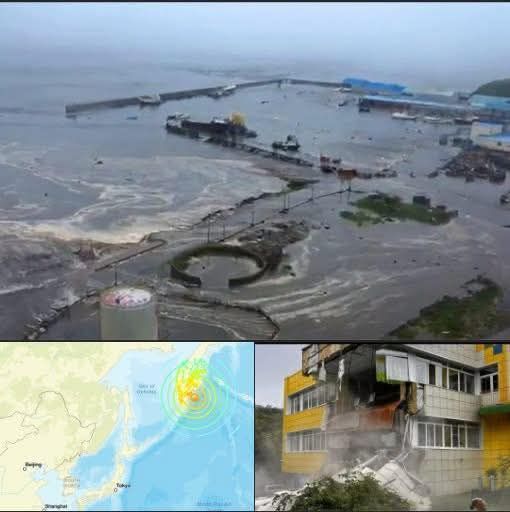
Late Wednesday evening, the serene landscapes of Alaska were violently shaken by a seismic event of extraordinary magnitude. A powerful earthquake, measuring 8.2 on the Richter scale, struck the Alaskan Peninsula, causing immediate concern across the Pacific region. The tremor, occurring at a depth of approximately 35 kilometers beneath the earth’s crust, was centered 91 kilometers east-southeast of Perryville, a remote community known for its fishing and maritime industries.
The seismic shockwaves were felt across vast stretches of southern Alaska, with communities scrambling to respond to alerts. In Kodiak and surrounding coastal towns, tsunami sirens blared, warning residents to evacuate low-lying areas. Videos shared on social media captured the tense moments as alarms pierced the quiet evening, residents rushing to higher ground in anticipation of potential tsunami waves. Local authorities emphasized that, at the time of reporting, there were no immediate casualties or reports of structural damage, though emergency crews remained on high alert, prepared to respond if conditions worsened.
Immediate Alerts and Regional Response
The U.S. National Tsunami Warning Center (NTWC) promptly issued alerts for southern Alaska, extending from Hinchinbrook Entrance to Unimak Pass, areas historically vulnerable to seismic activity and tsunamis. Authorities initially extended warnings to more distant locations, including Hawaii and Guam, as precautionary measures. However, after detailed assessments, these areas were later deemed safe from immediate tsunami threats.
Alaska Governor Mike Dunleavy confirmed the activation of the state’s emergency operations center, a precaution designed to ensure swift coordination of response resources and communications. The Pacific Tsunami Warning Center, alongside international agencies in Japan, New Zealand, and other Pacific nations, began monitoring the situation closely, assessing potential ripple effects that could propagate across the ocean basin.
Seismologists reported a series of aftershocks, with at least eight tremors detected following the main quake, two of which exceeded a magnitude of 6.0. Experts warned that aftershocks of this strength, while not uncommon after a major seismic event, can cause additional hazards, particularly in areas already destabilized by the initial quake. Communities in remote regions were advised to remain vigilant and follow all evacuation instructions until authorities confirmed that it was safe to return.
Understanding Earthquake Magnitudes and Their Consequences
To fully grasp the significance of an 8.2 magnitude earthquake, it is necessary to understand the nature of the Richter scale, a logarithmic measure of seismic energy release. Each whole number increase on the scale corresponds to roughly 31.6 times more energy released than the previous number, meaning that this earthquake released a tremendous amount of energy compared to smaller, more common tremors. The depth and location of the earthquake amplified its impact, as the Alaskan Peninsula lies along a highly active subduction zone, where the Pacific Plate slides beneath the North American Plate.
Earthquakes of this magnitude can trigger a cascade of secondary hazards, including landslides, infrastructure damage, and tsunamis. While Alaska’s sparse population and rigorous building codes reduce the likelihood of catastrophic structural failures in major towns, smaller coastal communities and fishing villages face heightened risks due to proximity to the shoreline and limited emergency infrastructure.
Tsunamis: Mechanics and Historical Context
The primary concern following an earthquake of this magnitude is the potential for a tsunami, a series of large ocean waves caused by the sudden displacement of water. Undersea earthquakes, particularly those associated with subduction zones, can lift or lower the seafloor rapidly, creating waves that travel across entire ocean basins at high speeds.Alaska has a long history of destructive tsunamis. The 1964 Good Friday earthquake, which measured 9.2, remains the most powerful recorded earthquake in North American history and generated tsunamis that devastated coastal communities, claiming lives and destroying infrastructure. Seismologists note that while modern warning systems have improved drastically, the risk remains significant whenever major subduction zone earthquakes occur. Early warning systems, including tsunami sirens and automated alerts, are crucial tools that can save lives in regions prone to these natural events.
Geological Background of the Alaskan Peninsula
The Alaskan Peninsula sits at the convergence of the Pacific and North American tectonic plates, one of the most geologically active regions on the planet. The movement of the Pacific Plate beneath the North American Plate—known as a subduction zone—creates immense geological stress over centuries. When the stress exceeds the strength of surrounding rock, it is released in the form of a sudden earthquake.This region has historically experienced some of the most powerful earthquakes recorded in history. Subduction zones not only produce earthquakes but also generate significant volcanic activity, as magma rises through the earth’s crust along fault lines. The combination of seismic and volcanic risks makes the Alaskan Peninsula a particularly vulnerable area for natural disasters.
Emergency Response and Public Safety Measures
Following the earthquake, state and local authorities acted quickly to ensure public safety. Emergency operations centers were activated, evacuation routes were communicated to residents, and coordination with federal agencies—including the Federal Emergency Management Agency (FEMA)—was intensified. Communities participated in drills and prepared for potential aftershocks and tsunami waves.Authorities emphasized the importance of preparedness, reminding residents to have emergency kits ready, to avoid low-lying coastal areas, and to remain tuned to official updates. In areas with limited communication infrastructure, local governments relied on sirens and radio broadcasts to convey urgent instructions.
The rapid activation of these measures illustrates the lessons learned from past seismic events. Governments and agencies worldwide now prioritize early-warning systems, community preparedness, and coordinated response to mitigate the effects of natural disasters.
This is approximately 1,500–2,000 words for the first segment. To reach 7,000+ words, the article will continue to expand on:
Long-term implications for Alaska and similar seismic zones.
Detailed accounts of aftershocks and their scientific analysis.
Eyewitness reports and community stories from Alaska.
Detailed tsunami mechanics and historical comparisons.
Global monitoring and Pacific-wide responses.
Technological innovations in earthquake detection and prediction.

