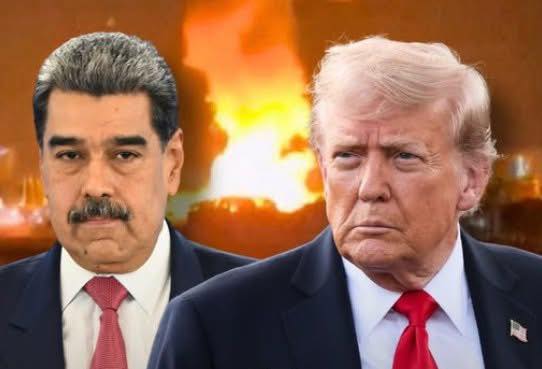
In the early hours of January 3, 2026, dramatic claims began circulating online that Venezuelan President Nicolás Maduro had been seized from Caracas.
Flown out of the country by the United States. What began as an explosive post on social media quickly became a flashpoint illustrating how high‑stakes geopolitical.
Events can generate uncertainty, misinformation, and fear before clear facts have fully emerged. In the middle of that chaos, millions of people around the world woke up to their phones buzzing with dramatic claims — not all of which had been independently verified.
What follows is a careful, chronological, and highly detailed account of what was claimed, what has been reported by reliable sources, and what remains unclear.
The Online Explosion: How the Claims Spread
The first major public trigger was a post by Former U.S. President Donald Trump on Truth Social in the early morning hours, asserting that U.S. forces had carried out a “large‑scale strike” against Venezuela and had “captured” President Maduro and his wife, Cilia Flores, and flown them out of the country.
Trump said the operation was conducted “in conjunction with U.S. law enforcement” and signaled that more details would follow at a scheduled press conference.
Within minutes, screenshots, reposts, and clipped portions of Trump’s announcement were circulating on platforms like X (formerly Twitter), Facebook, TikTok, and Instagram.
Accounts supportive of and opposed to the claim began amplifying the message — some with dramatic captions, some with uncertainty, and some with outright skepticism.
Even before independent verification, public reactions included shock, disbelief, and anxiety about the possibility of a covert operation targeting the leader of a sovereign nation.
On the Ground: Caracas in Confusion
Simultaneously, residents in Caracas reported unusual activity:
Loud explosions were heard in parts of the city, particularly near military installations, according to early reports published by global news outlets.
Videos shared online showed bright flashes in the sky and aircraft overhead — footage that was widely reposted without clear context or reliable geolocation.
Some users on social media described the night as one of uncertainty, with witnesses unsure whether they were seeing military action, routine aircraft, or something else entirely.
These early reports contributed to public unease precisely because they were real sensory experiences — explosions, aircraft, lights — yet lacked clear information about their cause or origin.
What Reliable Reporting Actually Confirms
By mid‑morning on January 3, multiple reputable news organizations and official sources had begun to publish verified details that give structure to the unfolding story. These include:
- Major U.S. Military Operation Confirmed
According to reports from news agencies such as Reuters, Associated Press, and PBS, the United States did conduct military strikes in Venezuela and later announced its intention to seize Maduro and his wife.
The U.S. operation — identified as Operation Absolute Resolve in open‑source sources — reportedly involved:
Airstrikes on locations across northern Venezuela, including around Caracas.
Targeting of multiple sites, including strategic military installations.
The capture of Nicolás Maduro and Cilia Flores by U.S. forces, who were then allegedly flown to New York to face federal charges.
These developments — once independently reported by major outlets — provided the first credible confirmation of a U.S. strike and the claim of Maduro’s capture.
Government Statements: Competing Narratives
One of the reasons the situation initially felt so confusing is that there were multiple, conflicting official responses:
U.S. Position
Former President Trump publicly asserted that the United States had successfully captured Maduro and his wife.
U.S. officials described the operation as intended to bring Maduro to justice, citing long‑standing indictments related to allegations of drug trafficking and corruption.
Venezuelan Government Response
Venezuela’s Vice President, Delcy Rodríguez, issued statements denying knowledge of Maduro’s whereabouts and demanding proof of life for both Maduro and Flores.
Maduro’s government condemned the operation as a “criminal attack” and accused the United States of violating Venezuelan sovereignty.
This competing official narrative — one from the U.S. government and another from the Venezuelan government — contributed to early confusion, as each side offered starkly different descriptions of what was happening.
Why the Confusion Spread So Rapidly
Several factors combined to make the early hours of the situation especially fertile ground for misinformation and partial understanding:
- Speed of Social Media Amplification
In modern crises, online platforms amplify unverified claims within seconds. A single post from a high‑profile account can be shared millions of times before traditional media verifies the facts.
In this case, Trump’s Truth Social post was one such catalyst.
- Sensory Evidence Without Context
Videos and photos of explosions or aircraft in Caracas were widely shared — but lacked immediate verification of where, when, and why these events occurred.
Sensory data without clear context often leads viewers to fill in the gaps with narratives that feel plausible but may not reflect the full picture.
- Deep Political Divisions
Global political polarization ensured that many audiences interpreted the event through ideological lenses.
Supporters of Trump or of Maduro quickly took sides on social media, amplifying interpretations that suited their political viewpoints.
- Limited Official Information Early On
Governments and major news organizations often take hours or days to confirm details during complex military operations. In the absence of immediate, verified information, rumors and speculation can grow rapidly.
How Misinformation Is Different From Unverified Claims
It’s important to distinguish:
Misinformation — false or misleading information shared without intent to deceive.
Disinformation — false information shared intentionally to mislead.
Unverified reports — claims circulating that have not yet been confirmed by reliable sources.
In the initial confusion surrounding Maduro’s capture, much of what was shared online was either unverified or came directly from one side of the dispute.
As more official reporting emerged, parts of the narrative began to align with reliable sources, but early social media claims still lacked confirmation and should be read with caution until thoroughly corroborated by multiple independent outlets.
Verified Developments After Initial Confusion
As reliable reporting caught up with the real‑time spread of claims, several key points became clearer through sources such as AP, Reuters, PBS, and Wikipedia:
Confirmed Strikes and Military Action
The U.S. military did launch airstrikes on Venezuela early on January 3, 2026.
Explosions were reported in the capital and other areas.
Satellite imagery later confirmed damage to key Venezuelan military infrastructure.
Capture and Detention
U.S. authorities stated that Maduro and his wife were taken into custody and transported to the United States.
Attorney General Pam Bondi announced that Maduro and Cilia Flores had been indicted in federal court on drug‑ and corruption‑related charges.
International and Legal Ramifications
Many governments and international organizations reacted with concern, condemning the strike as a violation of international law and Venezuelan sovereignty.
Others expressed support or cautious acknowledgment of the unfolding situation.
Disputed Details
Despite growing confirmation of some aspects, exact details of Maduro’s capture and the full sequence of events are still developing — including independent confirmation of his location immediately after the operation and full accounting of on‑ground actions in Caracas. News organizations are continuing to investigate and corroborate reporting.
Why This Matters: Trust, Truth, and Global Stability
The early confusion surrounding claims about Maduro’s capture highlights several enduring truths about public discourse during crises:
- Verification Takes Time
Reliable reporting often lags behind viral social media claims. Fact‑checking and confirmation require multiple independent sources, direct statements from officials, and verified media footage. - Official Claims Are Not the Same as Confirmed Facts
A statement from a political leader — even if subsequently corroborated by other sources — must be weighed against independent reporting.
In this case, initial claims were quickly reflected by media outlets, but some details were still under investigation as journalists worked to confirm them. This underscores why misinformation can flourish early.
- Psychological Impact of Incomplete Information
Unverified dramatic claims can create public anxiety — especially when they involve military action, national leaders, and international relations.
This can influence public opinion, provoke speculation, and fuel instability even before the full picture is understood.
- The Role of International Law and Transparency
Events like military strikes and capture of a sitting president are matters not just of national news but of international relations, law, and regional stability.
Clear facts are essential for evaluating legality, human rights implications, and future diplomatic consequences.
A Moment of Global Uncertainty
Whether the true end result is framed as a law‑enforcement action, a military intervention, or something in between, the way the story spread online illustrates the fragile intersection of information, perception, and power.
As the situation continues to evolve, verified reporting from trusted global news organizations remains the best source of factual updates, while unverified social media posts should be approached with caution — especially in moments of high emotion and geopolitical stakes.
In an era where information travels instantly, the world can feel thrown into turmoil by dramatic allegations long before reality has fully emerged.
The story of Maduro’s capture — clothed in both verified facts and early uncertainty — exemplifies just how quickly confusion, fear, and speculation can outpace clarity, and why careful, evidence‑based reporting matters more than ever.