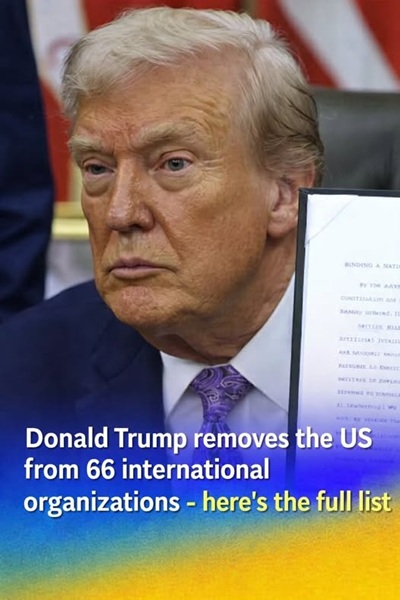
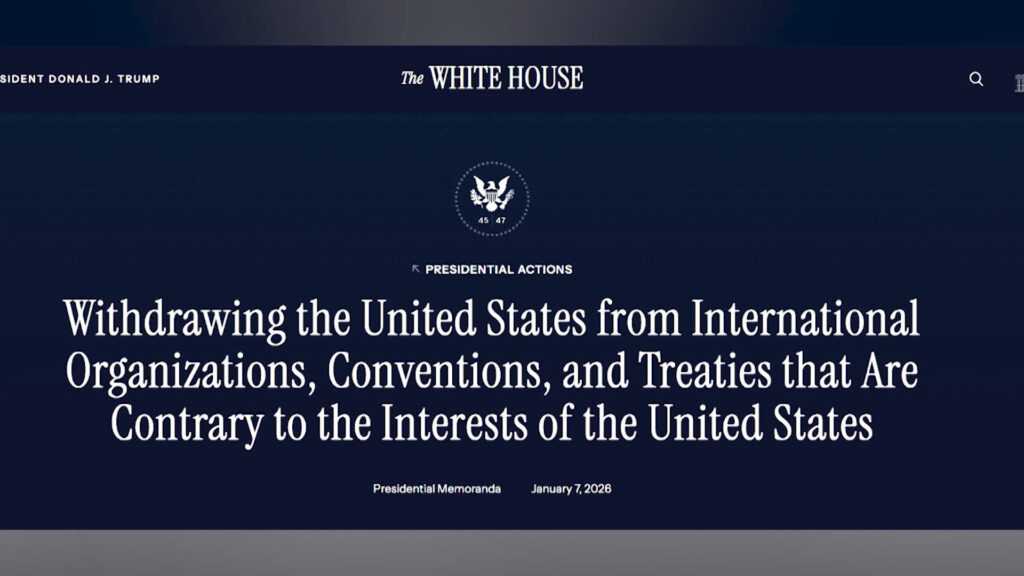
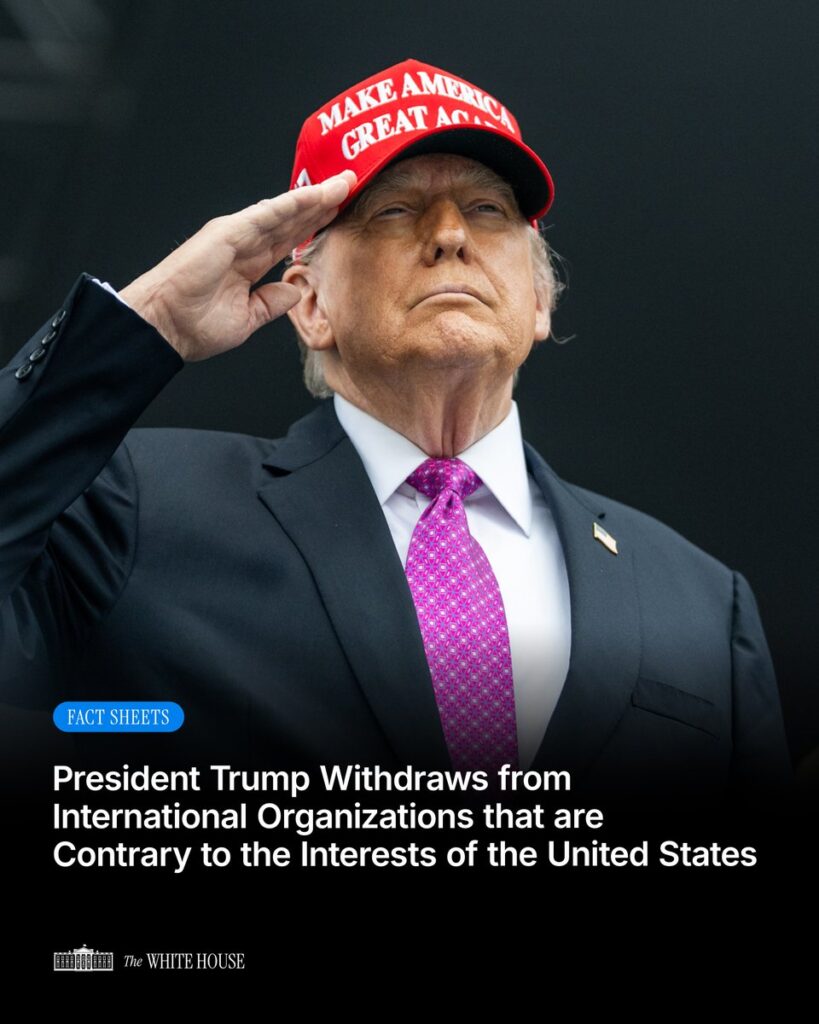
In a sweeping and unprecedented move, U.S. President Donald Trump announced that the United States would withdraw from dozens of international and United Nations-affiliated organizations
Signaling a profound shift in American engagement with the global community. According to an official memo issued by the White House.
The administration intends to sever ties with 35 non-UN international organizations and 31 UN entities. This step is part of a broader series of policy changes that have defined the current administration’s “America First” approach, which emphasizes national sovereignty, domestic priorities, and a selective engagement in global governance frameworks.
The memo outlines the rationale behind the withdrawals, citing a perceived misalignment between U.S. strategic interests and the agendas pursued by these international bodies.
Officials have characterized several organizations as promoting “globalist agendas, radical climate policies, and ideological programs” that conflict with what they describe as the sovereign interests of the United States.
By redirecting resources and attention away from these entities, the administration argues, taxpayer funds can be better allocated to domestic initiatives, including infrastructure development, healthcare improvements, and economic support programs.
Among the notable organizations impacted are UN Women, the United Nations Population Fund (UNFPA), and multiple climate-focused institutions and agreements.
UN Women, established to promote gender equality and empower women globally, has long received U.S. funding as part of America’s international development aid commitments.
Similarly, the UNFPA supports reproductive health and family planning programs around the world. The decision to withdraw from these organizations signals a major policy recalibration, with the administration explicitly linking funding cuts to concerns over ideological alignment and perceived global overreach.
This announcement follows a year marked by substantial foreign policy shifts. In addition to withdrawing from select UN bodies, the administration has implemented significant changes in areas such as immigration policy, international health cooperation, climate policy, and environmental regulation.
Last year, the United States notably abstained from the UN climate summit, an event it had participated in for nearly three decades, underscoring a deliberate strategy to disengage from international climate negotiations.
The White House justified this absence as a measure to protect U.S. economic interests and maintain sovereignty over national environmental policies, arguing that prior global agreements imposed obligations without sufficient accountability or tangible benefit for American citizens.
The memo emphasizes that the withdrawals involve ending participation or funding “to the extent permitted by law.”
This distinction is important, as certain U.S. commitments to international organizations are governed by treaties or congressional appropriations, which cannot be terminated unilaterally by executive action.
Nevertheless, administration officials maintain that these changes are legally permissible and consistent with the broader executive mandate to safeguard national interests.
While the announcement represents a significant reduction in U.S. involvement, it is not without historical precedent. During his first term, President Trump orchestrated major pullbacks from international institutions, including his administration’s decision to leave the Paris Climate Agreement and the announcement of plans to exit the World Health Organization (WHO).
In both instances, the administration cited concerns over sovereignty, economic cost, and perceived inefficiencies or biases in international governance structures.
The current expansion of withdrawal efforts represents a continuation and intensification of that policy trajectory, extending beyond climate and health organizations to include institutions focused on trade, energy policy, arms monitoring, peacebuilding, development, and human rights.
Trade and economic organizations affected by the policy shift include several bodies within the UN framework as well as non-UN entities that coordinate multinational trade agreements, monitor global economic trends, and facilitate international development financing.
By withdrawing from these institutions, the administration asserts that the United States can exercise greater discretion over trade policies, circumvent obligations it views as limiting domestic economic flexibility, and prioritize bilateral agreements that are aligned more closely with national priorities.
In the realm of climate and environmental governance, the decision carries potentially far-reaching implications. Agencies and committees linked to climate policy, carbon reduction initiatives, and international environmental cooperation will experience reductions in U.S. support.
The administration frames these withdrawals as a defense against what it describes as costly and ineffective mandates that interfere with domestic energy production, industrial competitiveness, and economic growth.
Environmental advocacy groups and international climate negotiators, however, have expressed concern that the U.S. retreat could undermine global efforts to mitigate climate change, reduce emissions, and coordinate multinational strategies for sustainability.
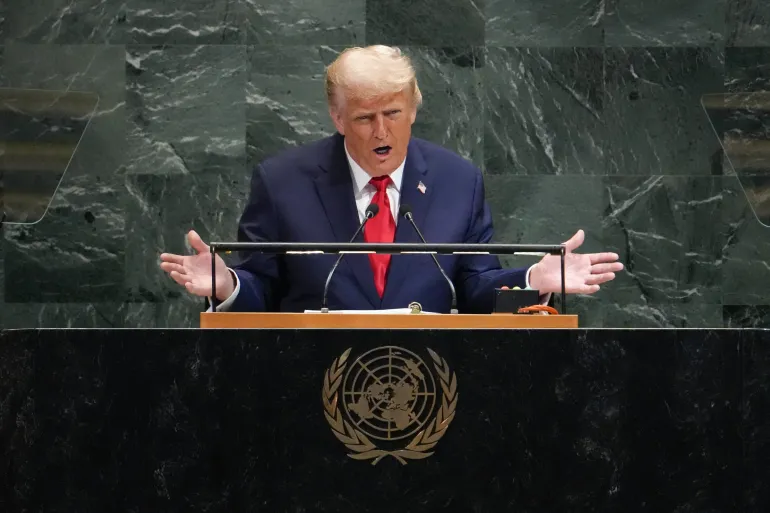
Human rights and development organizations are also impacted. UN entities dedicated to health, population control, gender equality, and human rights promotion, including the Office of the High Commissioner for Refugees (UNHCR) and development agencies like the UN Development Programme (UNDP), will face reduced engagement and support from the United States.
These withdrawals represent not only a change in financial contributions but also a symbolic shift in America’s role as a global actor.
For decades, the United States has been a leading donor and advocate for initiatives that address international humanitarian crises, health emergencies, and systemic development challenges. By limiting participation, the administration signals a prioritization of domestic concerns over global cooperative frameworks.
The policy also raises questions about U.S. influence in multilateral institutions. Historically, American leadership within the UN system and other international bodies has allowed the United States to shape decisions, direct funding priorities, and exert diplomatic leverage in ways that align with national security and economic objectives.
Critics argue that withdrawal risks ceding influence to other nations, reducing America’s ability to steer international standards, humanitarian initiatives, and trade agreements in directions consistent with U.S. interests.
Proponents, conversely, claim that disengagement is a strategic assertion of independence, emphasizing that U.S. sovereignty and taxpayer accountability must come first.
The administration’s rationale also references ideological concerns. Officials have repeatedly framed certain organizations as pursuing social and political agendas that diverge from American values or democratic priorities.
This includes programs perceived as promoting policies in conflict with domestic legislation, conservative principles, or economic strategies.
By limiting involvement in these entities, the White House argues, the United States can maintain greater control over both foreign aid expenditures and the cultural or ideological messages supported by American funding.
The announcement of U.S. withdrawals from dozens of international and United Nations organizations has generated immediate and widespread attention from policymakers, analysts, and global observers.
The policy has been described by administration officials as a bold reaffirmation of American sovereignty and fiscal prudence, while critics argue it may undermine U.S. credibility, diminish influence abroad, and weaken multilateral efforts on critical global issues such as climate change, health, development, and human rights.
Scope of Withdrawal and Organizational Impact
According to the memo, the U.S. will cease or substantially reduce participation in 31 UN-affiliated bodies, including agencies focused on development, humanitarian aid, population health, human rights, and climate policy. Among these, UN Women, the UN Population Fund, and the UN Development Programme are highlighted.
UN Women has historically coordinated programs to advance gender equality, empower women globally, and reduce gender-based discrimination in political and economic spheres.
Withdrawal from this body represents a major shift, signaling a U.S. decision to distance itself from direct involvement in international gender policy initiatives.
The UN Population Fund (UNFPA), responsible for supporting reproductive health services, family planning, and maternal health programs worldwide, is also affected. U.S. funding for UNFPA has been a point of contention in previous administrations, often reflecting broader ideological and policy debates around family planning and population control.
The Trump administration emphasized that U.S. funds should instead prioritize domestic initiatives or multilateral projects aligned with U.S. strategic interests.
Beyond these, 31 non-UN international organizations are included in the withdrawal list. These span diverse areas such as global trade oversight, peacebuilding, arms monitoring, climate research, and international development funding.
Organizations such as the International Energy Agency, World Bank-affiliated regional development bodies, and arms control monitoring committees are among those affected. The memorandum indicates that U.S. participation in technical advisory roles, funding programs, and policy-shaping committees will be curtailed, with potential ripple effects across international operations.
Economic and Trade Considerations
From an economic perspective, the administration frames the withdrawal as a mechanism to reduce expenditures on multilateral organizations perceived as inefficient or misaligned with U.S. priorities. Critics, however, caution that this could lead to reduced influence in global trade policy, potentially limiting U.S. ability to shape international trade standards, monitor compliance, and negotiate agreements that benefit American businesses.
For example, participation in organizations monitoring supply chains, trade tariffs, or export regulations has historically allowed the United States to advance its economic interests and respond effectively to global market disruptions.
Supporters argue that disengagement provides the U.S. with more flexibility to negotiate bilateral agreements tailored to national interests, bypassing multilateral processes that can be slow, bureaucratic, or politically constrained by other nations’ agendas.
This approach aligns with the administration’s broader “America First” philosophy, emphasizing domestic economic growth, job creation, and sovereignty over multinational compromise.
Climate and Environmental Implications
The withdrawal from climate-focused UN bodies and related international agreements represents one of the most visible and internationally consequential aspects of the policy.
Agencies involved in monitoring greenhouse gas emissions, coordinating carbon reduction programs, and providing technical expertise to developing nations have historically relied on U.S. participation and funding.
The United States has been a major donor to climate initiatives, providing both financial support and technological expertise for global sustainability programs.
By stepping back, the administration asserts that the United States can pursue domestic environmental policies without being constrained by international agreements, which it views as potentially limiting energy production, industrial growth, and economic competitiveness.
Critics, including environmental advocacy groups, warn that reduced U.S. engagement may hinder international efforts to meet climate targets, disrupt coordinated research, and slow the adoption of global sustainability standards.
International climate negotiators have emphasized that U.S. leadership remains critical to advancing global carbon reduction goals and achieving binding agreements.
Humanitarian and Development Impact
Withdrawal from development and human rights-focused organizations could affect global programs addressing poverty, food security, health crises, and refugee assistance.
Agencies such as the UNHCR, which provides support for refugees and displaced persons, and development programs affiliated with the UNDP and other bodies rely significantly on U.S. contributions for operational budgets and program execution.
Reductions in funding or withdrawal from governance structures may impact ongoing programs in conflict zones, humanitarian emergencies, and regions facing systemic development challenges.
Officials defending the decision stress that funds redirected to domestic priorities could improve the efficiency and impact of U.S. foreign aid, potentially allowing targeted humanitarian assistance through bilateral channels or alternative partnerships.
This reflects a strategic pivot from multilateral to selective bilateral engagement. However, many experts caution that such a shift may weaken the global coordination necessary for disaster response, epidemic control, and refugee management, where multilateral collaboration has historically proven essential.
Political and Diplomatic Reactions
The reaction from international partners has been swift and mixed. Traditional U.S. allies in Europe and Asia have expressed concern over diminished participation, warning that such moves could reduce American influence in multilateral decision-making forums.
Diplomats emphasize that U.S. withdrawal may allow other major powers to fill the vacuum, potentially shaping international policy in ways contrary to U.S. strategic interests.
Domestically, the decision has generated a polarized debate. Supporters of the administration laud the move as a decisive assertion of sovereignty, with some analysts predicting increased control over U.S. funds, domestic economic policy, and political messaging abroad.
Critics argue that the step undermines decades of U.S. global leadership, erodes credibility with allies, and may weaken the country’s ability to respond to global crises, from climate disasters to health emergencies. Congressional voices have similarly split along ideological lines, with debates centering on the balance between fiscal responsibility, foreign engagement, and strategic influence.
Historical Context and Comparisons
Withdrawal from international organizations is not unprecedented in U.S. history. Past administrations have occasionally suspended participation in global bodies perceived as misaligned with U.S. interests.
Notable examples include temporary withdrawals from UN agencies, abstentions from certain international treaties, and recalibration of foreign aid commitments.
What distinguishes this current action is its scale and breadth, encompassing more than sixty organizations spanning multiple sectors, along with the clear framing of the move as a central component of a nationalist, “America First” foreign policy agenda.
Historical precedent provides both cautionary and instructive perspectives. In previous cases, reduced participation occasionally led to reduced global influence, shifts in alliance dynamics, and changes in funding dependencies, requiring subsequent administrations to navigate the consequences of disengagement.
Analysts note that the current withdrawals may similarly reshape international relationships, requiring strategic diplomacy to maintain bilateral cooperation while simultaneously retreating from multilateral frameworks.
Potential Long-Term Consequences
The long-term implications of the U.S. withdrawal from these international organizations are multi-faceted:
Global Influence: Reduced participation may diminish America’s ability to shape international norms, standards, and policy decisions, particularly in areas of trade, human rights, and environmental policy.
Humanitarian Programs: Programs dependent on U.S. funding, including refugee aid, reproductive health initiatives, and disaster relief efforts, may face disruptions, requiring alternative funding mechanisms or partners.
Diplomatic Relations: Allies may perceive the withdrawal as a retreat from global leadership, potentially impacting negotiations, treaties, and cooperative initiatives across a range of policy areas.
Domestic Policy Alignment: By reallocating funds to domestic priorities, the administration seeks to reinforce economic, energy, and social policies aligned with its vision of national sovereignty and fiscal prudence.
Experts emphasize that while the strategic assertion of independence may appeal to domestic constituencies, careful diplomacy will be essential to mitigate negative consequences for U.S. global standing and to ensure that essential international collaborations continue where they are vital.
Public and Media Response
Media coverage has highlighted both the scale of the withdrawal and its potential consequences. Opinion pieces range from strong support—emphasizing sovereignty, fiscal prudence, and independent policy-making—to sharp criticism, focusing on U.S. credibility, humanitarian obligations, and environmental responsibilities.
Social media discourse has mirrored this divide, with online debates reflecting polarized perceptions of U.S. leadership, international engagement, and the trade-offs between national interest and global cooperation.
Looking Ahead
As the policy moves from announcement to implementation, several questions remain: How will affected organizations adjust to reduced U.S. participation? What mechanisms will the United States use to maintain influence without formal engagement?
And how will allies respond to ensure continued collaboration on security, humanitarian, and environmental issues? The administration has signaled that additional evaluations and adjustments may follow, with the potential for selective re-engagement where strategic interests dictate.
Observers note that this policy may have broad implications beyond the immediate organizations affected, shaping U.S. foreign policy doctrine, influencing bilateral relationships, and setting precedents for future administrations.
The intersection of domestic political priorities, fiscal management, and global diplomacy underscores the complex trade-offs inherent in disengaging from multilateral frameworks while maintaining national leadership.
Ultimately, the withdrawal from dozens of international and UN organizations reflects a deliberate pivot toward sovereignty-first policymaking, a reshaping of U.S. global engagement, and a recalibration of resources in line with domestic priorities.
The broader consequences—for diplomacy, development, climate action, and global perception—are likely to unfold over the coming years, as the United States negotiates its place in an increasingly interconnected world.