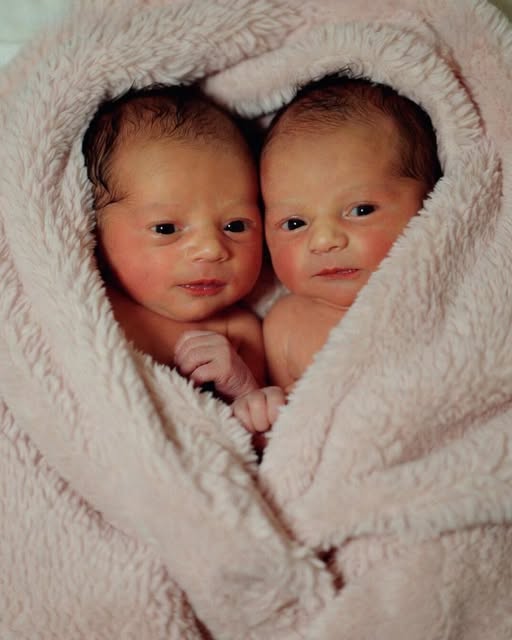
Twelve years ago, on a cold Tuesday morning when the air felt as sharp as broken glass, my life was defined by the constant hum of a garbage truck and the quiet struggle to make ends meet. At 41, I look back at that early-morning trash route as the moment the universe decided to challenge my heart. I was Abbie, a sanitation worker in a grime-covered jumpsuit, and my husband, Steven, was at home recovering from a difficult surgery. Our life was simple, punctuated by the weight of bills and the quiet ache of an empty home.
As I drove through the dark streets, my headlights swept across something out of place: a stroller, abandoned in the middle of the sidewalk, alone in the freezing cold. It wasn’t placed near a doorway or beside a parked car; it was simply left there, exposed to the elements. A cold shiver gripped me as I threw the truck in park and ran toward it. Inside, wrapped in thin, mismatched blankets, were two tiny twin girls—barely six months old. Their cheeks were flushed red from the bitter wind, but as I leaned in, I could see the mist of their breath in the frigid air.
There was no note, no sign of a frantic parent nearby, and no warmth to be found. With trembling hands, I dialed 911, shielding the stroller from the wind against a brick wall. By the time the police and the social worker arrived, silence followed their departure with the girls. Watching that car drive away with two nameless babies felt like a wound that would never heal.
That night, the dinner table became the place for a quiet reckoning. I couldn’t stop thinking about their wide, dark eyes. When I shared my fear with Steven—that they would be split apart, lost in a system that lacked compassion—he didn’t remind me of our empty savings account or his growing medical expenses. Instead, he held my hand and said the words that would change everything: “You already love them. Let’s at least try.”
The process of becoming their parents was grueling—endless home visits, psychological evaluations, and personal questions that felt invasive. Just a week into it, the social worker came with unexpected news. “The twins are profoundly deaf,” she told us. “They’ll need constant care, special education, and a lifetime of adaptation. Most families would walk away now.”
I didn’t even need to glance at Steven to know his response, but I did. He didn’t flinch. I turned to the social worker and replied, “I don’t care if they’re deaf. I care that they were left on a sidewalk. We’ll learn whatever we have to.”
We named them Hannah and Diana. The early months were a blur of beautiful chaos. While other parents were awakened by cries, we learned to communicate through the vibrations of footsteps and the flickering of lights. We enrolled in American Sign Language classes, practicing until our fingers ached and our minds were worn. Steven would joke during late-night study sessions that I accidentally asked the babies for a potato instead of more milk. We were exhausted, our bank account perpetually near empty, and we sold whatever we could to afford their needs—but our home finally felt like a sanctuary.
As the years passed, Hannah and Diana grew into a powerful storm of creativity and energy. We fought tirelessly for interpreters at their schools and stood firm when strangers in the grocery store asked, “What’s wrong with them?” I always answered the same way: “Nothing. They’re deaf, not broken.”
By the time they were twelve, the girls had developed their own private language—a shorthand of signs only they understood, moving faster than words. Hannah became an exceptional artist, filling sketchbooks with intricate clothing designs, while Diana took to engineering, fascinated by how things were made. One afternoon, they came home from school with news of a design competition for adaptive clothing for kids with disabilities. “We’re a team,” Diana signed, grinning fiercely. “Her art, my brain.”
They spent weeks hunched over the kitchen table, designing hoodies with specialized pockets for hearing aids, pants with magnetic side closures for easy dressing, and fabrics chosen with sensory sensitivities in mind. “We probably won’t win,” Hannah signed, shrugging as they submitted their project, “but it’s cool to show people what we need.”
Life went on until one random afternoon this year. My phone rang while I was stirring soup, still in my work boots. The caller was from BrightSteps, a major children’s clothing brand. They hadn’t just seen the girls’ project; they were blown away by it.
“We want to turn their ideas into a real product line,” the representative said. “We’re offering a design fee and royalties.” When she mentioned the contract’s value—$530,000—I nearly dropped my phone into the soup. My thoughts flashed back to that cold morning, to the frozen sidewalk, and to the two little breaths in the dark.
When the girls got home, I sat them down at the table. Slowly, I signed the news, making sure each word had weight. I told them that what the world had once seen as a disability was, in fact, their greatest strength. Their desire to make life easier for others had just changed our lives forever.
The room was filled only with the sound of their hands moving. “Are you serious?” Hannah signed, her eyes shimmering with tears.
“I’m serious,” I replied. “Because you thought of others, the world finally saw you.”
They rushed toward me, a whirlwind of arms and silent tears. “Thank you for taking us in,” Diana signed, her hands pressed against my shoulder. “For not thinking we were too much.”
I held them tightly, looking at the strong, talented young women they’d become. People often say that I saved them that cold Tuesday morning. They see the sanitation worker who rescued abandoned babies and think it’s a story of charity. But as I sat there, with a half-million-dollar contract on the table and my daughters in my arms, I realized the truth: those two girls didn’t just find a home—they gave me a purpose I didn’t know I was missing. They didn’t just learn a language; they taught me how to listen with my soul.
I may have brought them in from the cold, but over the past twelve years, it’s Hannah and Diana who have truly saved me.