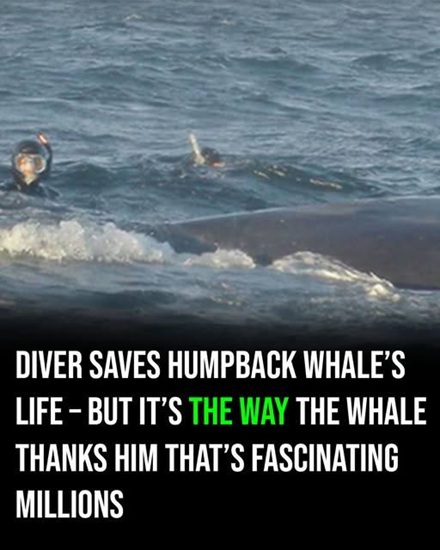
The waters surrounding the Farallon Islands, roughly 30 miles off the coast of San Francisco, are famous for their stark beauty—but also for their unforgiving conditions.
Cold, dark, and often unpredictable, the currents and tides here demand respect, even from seasoned mariners.
To the casual observer, the islands appear almost otherworldly: jagged rocks jutting from the mist, the surface glinting under low-hanging clouds, seals and seabirds dotting the horizon. But beneath the beauty lies danger, and on a seemingly ordinary September day, the ocean was about to test one man’s courage and resolve in a way no routine conservation work ever could.
James Moskito, a marine conservation volunteer with years of experience navigating the Pacific waters, had begun his day as he had countless others: scanning the waves with his small team, checking for signs of entanglement, pollution, or other distress among local marine life.
The Farallon Islands are home to hundreds of species of marine mammals, including gray whales, seals, and the occasional orca. The team’s mission, while dangerous, was clear: monitor the ecosystem, document human impact, and respond when necessary.
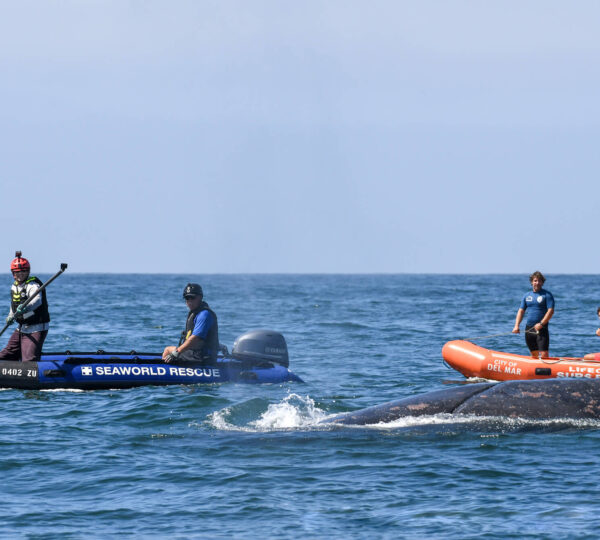
On this day, however, the usual rhythm of observation was interrupted. Far off to the east, near a slight swell in the water, James noticed something unusual.
At first, it appeared to be a dark, rounded shape moving slowly near the surface. His trained eye narrowed. Most whales keep a healthy distance from boats and humans.
This one was different. One eye remained above water, watching him intently, its movements deliberate yet tired. To an untrained observer, it might have seemed like curiosity. But James knew the signs. The whale wasn’t playing. It was in distress.
As he drew closer in the small boat, the reality became clear. A massive humpback whale, easily weighing over 30 tons, had become entangled in what appeared to be a heavy anchor and chain.
The metal had ensnared its tail, restricting its movement and sapping its energy. The creature’s usual fluid, graceful motions were replaced with jerky, exhausted thrashes, a distress signal that echoed the severity of the situation.
The anchor alone must have weighed close to 3,000 pounds, but combined with nearly a mile of thick, heavy chain, it had effectively imprisoned the animal in the open ocean.
The situation demanded immediate action—but also extreme care. Approaching a whale, particularly one this large, is dangerous under the best conditions.
A single panicked movement could injure divers or the animal itself. James knew this, yet hesitation was a luxury the whale didn’t have. Its life depended on decisive but careful intervention.
After a brief team meeting and risk assessment, James suited up for the rescue. The water temperature hovered just above 50 degrees Fahrenheit, cold enough to cause hypothermia if exposure was prolonged.
The currents shifted unpredictably, and waves tossed the small boat like a cork. Despite this, James’s movements were deliberate.
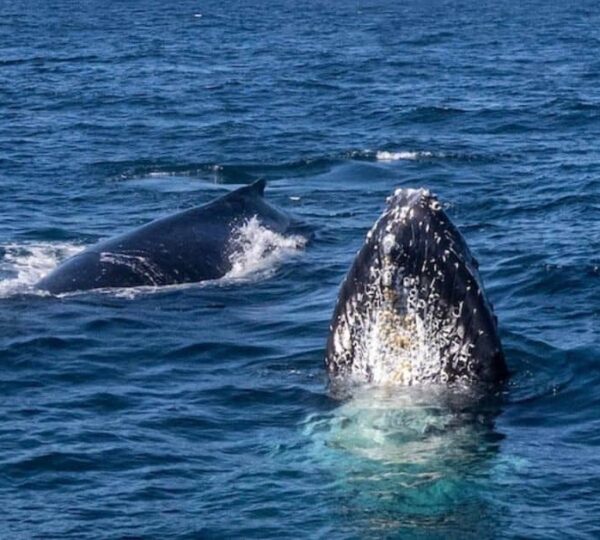
He entered the water slowly, allowing the whale to become accustomed to his presence. There was no sudden splashing, no rushing. Every stroke, every gesture, was measured—designed to convey calm rather than command.
As he approached the whale’s tail, the full extent of the entanglement became horrifyingly clear. The anchor’s massive flukes had dug into the soft tissue of the whale’s tail, and the chain was wrapped in tight loops, cutting into skin and muscle.
The whale’s exhaustion was evident. It surfed the surface just to breathe, exhaling powerful bursts of mist into the air. Its eye followed James steadily, as if recognizing the intent to help rather than harm.
In those moments, something profound passed between human and animal—a silent acknowledgment, an unspoken trust.
James signaled the team to prepare the cutting tools. The rescue required precision, endurance, and patience. Every cut had to be calculated.
Chains that weigh hundreds of pounds don’t easily release their grip, and anchors twisted with ocean currents create complex tension points. A miscalculation could be catastrophic.
The team used specialized tools designed for marine mammal entanglement—heavy-duty cutters capable of slicing through steel, but controlled enough to avoid damaging the whale’s flesh.
Hours passed in frigid water. James alternated between working on the chains and surfacing for air, each session exhausting but necessary.
The whale remained surprisingly cooperative, its movements slow and measured, surfacing when needed but never thrashing violently.
Witnesses later described a surreal stillness, a fragile balance of trust that allowed the rescue to proceed. It was as if the whale understood, instinctively, that the humans were allies in its liberation.
At one point, a particularly twisted segment of chain proved stubborn. James held his breath underwater, his muscles straining as he worked the cutter into position.
The chain groaned, metal scraping against metal, but eventually gave way. The anchor shifted slightly, its weight still immense but no longer constricting the whale. Each minor victory brought a sense of cautious optimism.
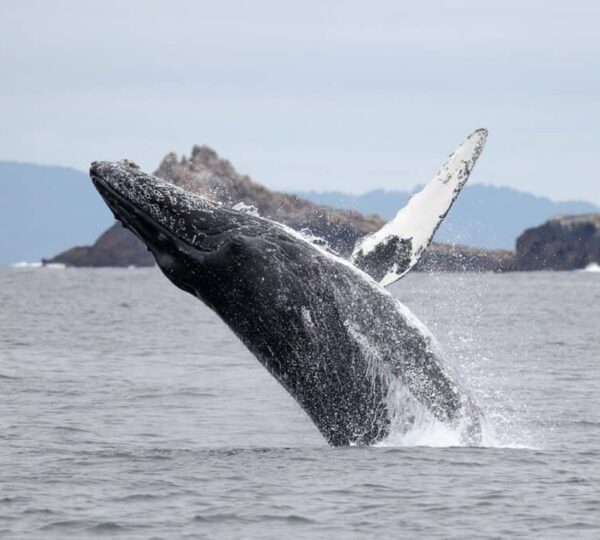
Finally, after hours of meticulous work, the last segment of chain was severed. The massive anchor, once a lethal prison, sank into the depths, leaving the whale unbound. And yet, the moment was not one of immediate disappearance or celebration.
The whale circled slowly, brushing by James’s body as if acknowledging the effort. There were no sounds, no dramatic gestures—just a quiet, profound connection that lingered in the cold air. Then, with a gentle flick of its massive tail, it swam away, finally free.
The impact of the rescue rippled far beyond the Farallon Islands. Local news outlets reported on the event, highlighting the danger, skill, and compassion involved.
Social media accounts shared videos and photographs, capturing the awe-inspiring size of the whale and the sheer scale of the human effort required to free it.
But the story resonated not for its drama, but for its intimacy. It revealed the intelligence and patience of marine life, the devastating reach of human debris into the ocean, and the quiet heroism of those willing to act with empathy and courage.
Experts later reflected on the significance of the event. Dr. Emily Harding, a marine biologist familiar with the Farallon Islands’ ecosystem, noted: “What makes this rescue extraordinary is not just the danger or scale, but the understanding that James and his team demonstrated. Approaching a whale in distress is always high risk, and the patience and care they exhibited is what ensured the animal’s survival.”
The anchor and chain entanglement was, unfortunately, not an isolated incident. Ocean debris—from fishing equipment to lost maritime anchors—continues to injure countless marine mammals each year.
Humpback whales are particularly vulnerable, as they often swim near shipping lanes and areas with heavy human activity.
Each entanglement reduces mobility, impairs feeding, and increases the risk of infections or predation. In this context, every rescue is not just an act of compassion but a critical intervention for the survival of the species.
For James Moskito, the rescue was both a professional responsibility and a deeply personal experience. He later reflected in interviews: “Being in the water with that whale, seeing its exhaustion, feeling its trust—it was humbling. You realize that courage isn’t about force. It’s about entering the unknown calmly, listening, and choosing empathy over fear.”
Indeed, the event became a teaching moment for volunteer conservationists worldwide. It highlighted the importance of specialized training, knowledge of marine animal behavior, and the mental resilience required for rescues in extreme environments.
It also underscored a philosophical point: that compassion, patience, and respect can be as powerful as physical strength when lives are on the line.
In the days following the rescue, scientists monitored the whale’s movements using tracking devices and visual confirmation. The animal returned to normal migration patterns, feeding in safer areas, and showing signs of full recovery.
Photographs from local observers captured the whale’s healthy dorsal fin and flukes, a testament to the resilience of these creatures when given a chance to recover.
For the team, the rescue left a lasting impact. “We were exhausted physically, mentally, and emotionally,” James recalled.
“But there was a sense of something deeper—an acknowledgment that the work we do matters in a real, tangible way. That whale’s life was saved, and in those moments, everything else fades into the background.”
The story has since been used in conservation education programs, highlighting both the risks posed by human debris in the ocean and the importance of intervention.
Schools and environmental organizations share the tale to inspire empathy, responsibility, and respect for marine life.
The Farallon Islands, while remote, have become emblematic of the broader challenges facing oceans worldwide: fragile ecosystems, human impact, and the ongoing need for dedicated stewardship.
Ultimately, the rescue of the humpback whale near the Farallon Islands stands as a testament to the power of quiet courage. It is a story that transcends headlines, social media clicks, and viral attention.
It reminds us that bravery often looks like calm focus rather than dramatic heroics, that empathy can create trust across species, and that one person’s deliberate, patient action can change the course of a life—sometimes tens of tons of life—forever.
James Moskito’s work that day exemplified the intersection of skill, knowledge, and compassion. The whale’s slow circling and eventual freedom serve as a reminder of the delicate balance between human activity and the natural world.
In an age of climate change, pollution, and habitat destruction, the rescue is not just an isolated act of heroism but a symbol of the ongoing responsibility humans bear toward the creatures we share the planet with.
In the end, the whale swam free, the anchor rested on the ocean floor, and the volunteers returned to shore, changed themselves by the experience. It is a story of patience, courage, and empathy—a quiet miracle in the cold waters off the California coast.
It is proof that sometimes, real heroism isn’t about force, speed, or spectacle. Sometimes, it is about entering cold water with calm resolve, trusting empathy over fear, and choosing compassion when the outcome is uncertain—and a life, or lives, hang in the balance.