Acts of kindness rarely announce themselves. Most of the time, they unfold quietly, witnessed by only a few people, and then disappear into the background noise of everyday life. But every so often, a small, ordinary moment breaks through the cynicism and reminds people what decency looks like when no one is asking for applause.
This is one of those moments.
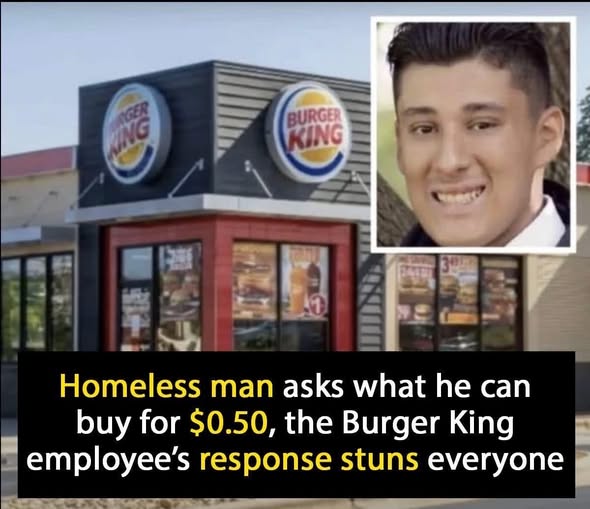
On an unremarkable day in May, Matthew Resendez was working a routine shift at a local Burger King. The restaurant sat in an area where homelessness was a familiar reality, and employees were used to seeing people come in not to order meals, but to warm up, ask for water, or quietly stand near the counter before leaving again. Nothing about the shift suggested it would be memorable.
Then a man walked in holding a handful of coins.
He didn’t look angry or demanding. He didn’t cause a scene. He simply approached the counter and gently asked a question that stopped Matthew cold.
“What can I get for fifty cents?”
For Matthew, the answer should have been simple. Company policy didn’t allow employees to hand out food. The register wouldn’t accept that amount. He could have apologized and sent the man on his way, like so many others had probably done before.
But he didn’t.
Instead, Matthew asked a different question.
“What would you order if you could?”
The man hesitated, then quietly replied that anything would help. He just needed something to stop the hunger pains.
That was all Matthew needed to hear.
Without making a show of it, he rang up a full, hearty meal. He didn’t announce what he was doing. He didn’t ask permission. When the total came up, Matthew pulled out his own debit card and paid for the order himself.
He handed the man the receipt, smiled, and told him to take a seat and relax while the food was prepared.
For the man, the moment was overwhelming. He hadn’t asked for generosity. He hadn’t expected kindness. He had simply hoped that fifty cents might be enough to buy a small piece of dignity for the day. Instead, he was given a full meal and something far rarer: respect.
The story could have ended there. A good deed completed, two lives briefly intersecting, then moving on. But someone else had been watching.
A woman seated in the restaurant noticed everything. She saw how Matthew treated the man, how there was no judgment in his voice and no hesitation in his actions. Afterward, she didn’t just leave impressed. She wrote to the company to let them know what kind of employee they had behind the counter that day. And she left Matthew a generous tip as a quiet thank-you for doing the right thing.
When Matthew got home and told his mother, Michelle Resendez, about the incident, he mentioned it casually, as if it were nothing worth highlighting.
But Michelle saw it differently.
She shared the story on social media, never imagining it would travel far beyond her circle of friends. Her words were simple and full of pride.
A homeless man had walked into the restaurant with fifty cents. Matthew asked what he would order if he could. Then he paid for the meal himself and told the man to sit down and eat. A stranger witnessed the kindness and made sure Matthew’s employer knew about it. Michelle ended her post by saying how proud she was to have raised a son with such a big heart.
The post spread faster than anyone expected.
Within hours, thousands of people were sharing it. Comments poured in from across the country, many from people who felt worn down by constant bad news and desperate for something good to believe in again. They saw in Matthew’s actions a reminder that compassion doesn’t require wealth, power, or influence—only awareness and choice.
Matthew himself didn’t see his actions as heroic. To him, it was obvious. Someone was hungry. He had the ability to help. So he did.
That mindset didn’t come from nowhere. According to those who know him, Matthew grew up learning that people are people first, no matter their circumstances. His mother has said that empathy was always part of how he saw the world—that he understood early on that hardship isn’t a moral failing and that dignity shouldn’t be conditional.
As the story continued to circulate, people praised Matthew’s character and Michelle’s parenting. Many said the story restored their faith in young people. Others pointed out how rare it felt to see someone act purely out of kindness without expecting anything in return.
What made the moment even more powerful was its simplicity. There were no cameras set up. No viral challenge. No staged generosity. Just a young man at work, confronted with a human need, choosing compassion over convenience.
For the homeless man, the impact went beyond a full stomach. Being treated with respect—spoken to directly, asked what he wanted, and trusted enough to sit and eat—meant something deeper. In a world that often looks past people like him, Matthew looked straight at him and saw someone worth caring about.
That kind of recognition lingers.
Stories like this resonate because they cut through the noise. They remind people that kindness doesn’t have to be dramatic to matter. It doesn’t require grand gestures or endless resources. Sometimes, it’s a meal paid for quietly, a question asked sincerely, and a decision made in a split second to do better than what’s required.
Matthew didn’t change the world that day. He didn’t solve homelessness or hunger. But he changed one moment for one person—and that was enough.
In a time when so many feel disconnected and disillusioned, that reminder mattered more than Matthew probably ever realized.