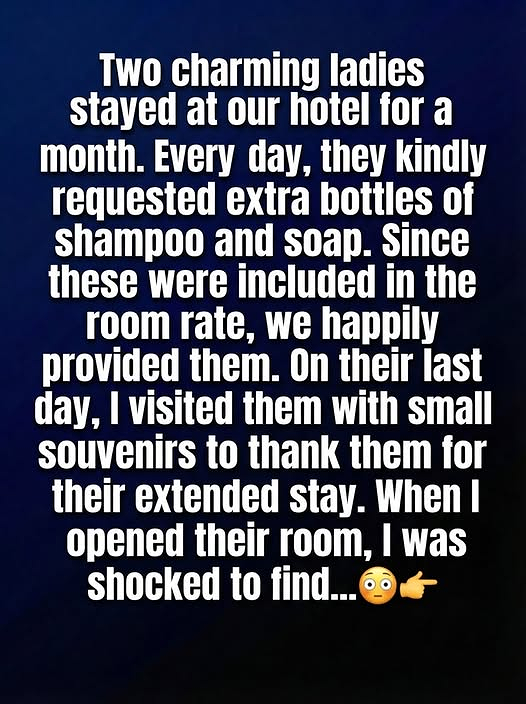
The hotel had hosted every kind of guest imaginable over the years—business travelers rushing through with rolling suitcases, honeymooners glowing with nervous excitement, families exhausted from sightseeing—but Lina still remembered the two women more clearly than almost anyone else. They arrived on a wet evening when rain pressed against the glass doors and the lobby smelled faintly of coffee and polish. They stepped inside laughing, shaking water from their coats, carrying nothing more than two modest suitcases and an ease that instantly softened the space.
Their stay stretched from days into weeks, and then into a full month. The hotel stopped thinking of them as guests and began thinking of them as fixtures. Housekeepers grew used to their door sign—sometimes requesting privacy, sometimes allowing service—and the kitchen staff learned their tea preferences by heart. They didn’t behave like tourists. They rarely asked for recommendations, rarely left the building for long. When they did go out, it was usually for brief walks, returning with damp shoes and quiet smiles.
Lina found herself curious, though she never asked questions. Years in hospitality had taught her that people came to hotels for reasons they didn’t always want explained. Some were escaping something. Some were waiting. Some were simply passing time until life clarified itself. These women felt purposeful, but not rushed. Calm, but not idle.
On their final day, Lina decided to do something she rarely did. She picked up two small souvenir keychains from the gift cabinet—simple metal pieces engraved with the hotel’s name. It wasn’t policy. Just instinct. A thank-you for a stay that had been unusually kind.
She walked down the quiet hallway toward their room, gifts in hand, rehearsing a friendly farewell. The corridor smelled faintly of cleaning solution and carpet shampoo. Everything felt normal, routine, expected.
She knocked, announced herself, and stepped inside.
Her smile stopped mid-expression.
Where there should have been clean lines and neutral décor, there were stacks—dozens upon dozens—of tiny shampoo bottles and neatly wrapped bars of soap. They lined the walls in careful rows, arranged by size and brand, some bundled in towels, others sorted into improvised categories. It looked less like a guest room and more like a meticulously organized supply depot.
For a brief, disorienting moment, Lina wondered if she had opened the wrong door.
But the women were there, sitting cross-legged on the bed, relaxed and smiling, as if nothing about the scene was unusual.
One of them caught Lina’s expression and laughed softly. Not embarrassed. Not defensive. Just amused.
The other woman nodded. “We always forget how it looks to someone seeing it for the first time.”
Lina stood frozen, her mind racing through policies, inventory counts, and imagined explanations she might have to give. Before she could speak, the first woman gestured around the room.
“We run a small shelter for homeless families,” she explained. “Mostly women and kids. Hygiene supplies are always the first thing to run out.”
The second woman leaned forward. “Hotels replace these items constantly. Sometimes they’re thrown away, barely used. We realized a long time ago that if we asked kindly, we could collect enough to last months.”
They spoke without drama, without pride. Just fact.
Lina felt the tension drain from her shoulders. The towering stacks no longer looked excessive or strange. They looked purposeful. Necessary. Quietly generous.
All the small requests suddenly rearranged themselves in her mind. The extra shampoo. The polite smiles. The gratitude that never felt performative. This wasn’t convenience. It was intention.
“I hope we didn’t cause any trouble,” one of the women added. “We always make sure it’s within policy.”
Lina shook her head, emotion tightening her throat. “No. Not at all.”
“You’ve all made this easier than you know,” one said. “Kindness makes our work possible.”
After they checked out and left quietly, as they had arrived, Lina returned to the room. It was empty now, stripped back to neutral walls and standard furnishings. Only a few forgotten bottles remained on the dresser, catching the light.
She stood there for a long moment, thinking.
She had worked hospitality for years. She thought she understood generosity. Tips left on pillows. Compliments to management. Seasonal gifts. But this was different. This was generosity disguised as ordinary behavior. Compassion hidden inside routine requests.
She learned that kindness doesn’t always announce itself. Sometimes it checks in quietly, smiles politely, and asks for small things. Sometimes it leaves behind nothing but an empty room—and a lasting reminder that even the most ordinary places can be part of something extraordinary.