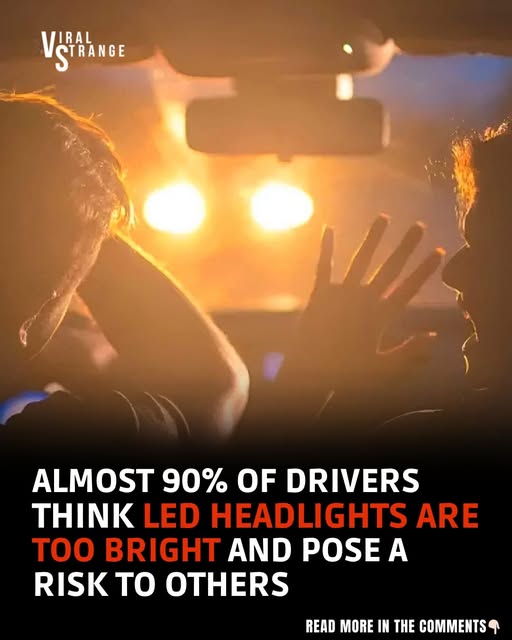
The glare hits you before you even fully register what’s coming. A sudden blast of white light floods your windshield, your pupils fail to adjust fast enough, and for a terrifying split second, you’re driving half-blind at highway speed. Your grip tightens on the steering wheel. Your heart jumps. Instinct takes over as you slow down or avert your eyes, hoping the lane ahead is still clear. Drivers around the world are describing the exact same experience, again and again. This is no longer just about headlights being “too bright.” For many, it has crossed into something far more serious: a daily, unavoidable safety threat.
As complaints pile up, frustration grows. Regulators hesitate, citing incomplete data. Engineers debate measurements, angles, and standards. Automakers defend designs that meet technical requirements on paper. Meanwhile, drivers keep asking the same unresolved question: how did something meant to improve safety make night driving feel more dangerous than ever?
LED headlights were once hailed as a breakthrough. Compared to older halogen bulbs, they offered whiter light, better energy efficiency, and significantly longer lifespans. In theory, they allowed drivers to see farther and react faster. And for the person behind the wheel of a car equipped with LEDs, that promise often feels true. The road ahead appears crisp and sharply defined. Signs glow clearly. Dark stretches feel less intimidating.
But for everyone else—the oncoming driver, the person in the next lane, the driver in a lower sedan facing a lifted SUV—the experience is completely different.
The intense, blue-white light emitted by many LED systems is far harsher on human eyes, especially at night. When those lights are mounted higher on trucks and SUVs, or when they’re misaligned by even a small margin, the beam hits directly at eye level. The result is glare so strong it can cause squinting, headaches, slowed reaction times, and brief moments of disorientation. At 60 or 70 miles per hour, even a second of impaired vision is not trivial. It’s the difference between correcting your lane position and drifting. Between braking in time and reacting too late.
What makes the situation more alarming is how common it has become. This isn’t a rare defect or an edge case. It’s a widespread, everyday experience for millions of drivers. Night driving, once merely tiring, has become stressful. Some people avoid driving after dark altogether. Others describe feeling tense every time headlights appear in the distance, bracing for the flash of light that will wash out the road ahead.
The problem is often dismissed as subjective—drivers being overly sensitive, older eyes struggling more, or nostalgia for “how things used to be.” But mounting evidence suggests otherwise. The issue isn’t imagination. It’s implementation.
The core technology isn’t inherently dangerous. The danger lies in how LED headlights are designed, regulated, and deployed. Current standards often focus on brightness limits in controlled testing environments, not real-world glare experienced by oncoming traffic. Headlight alignment is rarely checked after purchase, even though minor suspension changes, heavy loads, or simple wear can shift beams upward. Aftermarket LED kits, frequently installed without proper calibration, worsen the problem dramatically.
There are solutions—and many already exist.
Stricter glare regulations based on real-world conditions could force manufacturers to prioritize how headlights affect other drivers, not just the vehicle they’re mounted on. Mandatory alignment checks during inspections could prevent thousands of misdirected beams from blinding traffic every night. Adaptive headlight systems, which automatically adjust beam shape and intensity based on surrounding vehicles, offer one of the most promising paths forward, but their rollout has been slow and inconsistent.
Until meaningful change happens, drivers are left managing the risk themselves. They’re checking their own headlight alignment, avoiding cheap aftermarket conversions, flipping mirrors into night mode, and learning defensive habits to cope with sudden glare. They’re hoping that the next set of headlights cresting the hill won’t turn the road into a wall of white.
LED headlights were supposed to make driving safer. For many, they still can. But until the industry fully acknowledges how damaging uncontrolled glare can be, night driving will remain a compromise between seeing clearly and being seen safely. And no one should have to choose between the two.