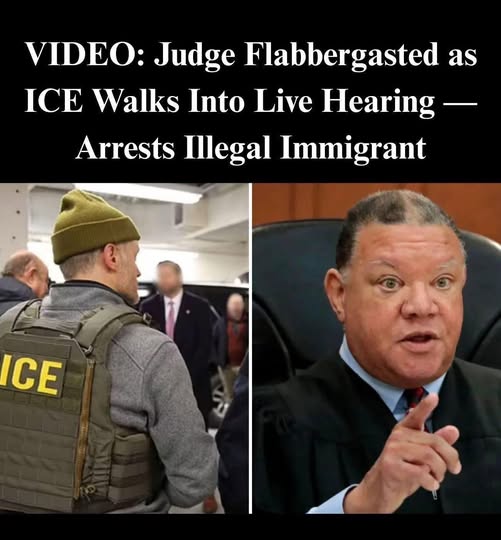
Boston ICE Agent Held in Contempt After Arresting Defendant Mid-Trial: A Detailed Look at Immigration Enforcement and Courtroom Rights.
In a rare and highly scrutinized legal event, a Boston Municipal Court judge recently held a U.S. Immigration.
Customs Enforcement (ICE) agent in contempt for detaining a defendant while his trial was ongoing.
The incident has reignited debates over the intersection of federal immigration enforcement and local judicial processes, highlighting the tension between law enforcement authority and the constitutional rights of defendants.
The Incident
On a routine morning last week, Wilson Martell-Lebron, a resident of Massachusetts and a native of the Dominican Republic, attended court for proceedings concerning charges of making false statements on his driver’s license application.
Specifically, he was accused of misrepresenting his identity, a misdemeanor offense under state law.
As Martell-Lebron left the courthouse, ICE agent Brian Sullivan apprehended him without prior notice to the court.
According to witness accounts and court documents, the arrest was carried out swiftly, and the ICE agents did not identify themselves before placing Martell-Lebron into a government vehicle.
The arrest took place during the opening stages of the trial, shortly after witnesses began providing testimony.
Judicial Response
Judge Mark Summerville of the Boston Municipal Court immediately expressed concern over the arrest, ruling that Sullivan had violated Martell-Lebron’s constitutional rights, particularly his right to due process and to confront witnesses against him.
“It’s a case of violating a defendant’s right to be present at trial and confront witnesses against him,” Judge Summerville stated from the bench. “It couldn’t be more serious.”
Following this ruling, Judge Summerville dismissed the charges against Martell-Lebron related to the driver’s license application, citing the violation of his rights.
The judge subsequently filed a contempt charge against Agent Sullivan, an unusual step that could prompt the Suffolk County District Attorney’s office to review whether additional charges should be pursued against the ICE agent.
Legal Implications
The Boston incident highlights the legal tensions that arise when federal enforcement actions intersect with local judicial proceedings.
Constitutional law provides that defendants in criminal cases have the right to be present during their trials and to confront witnesses.
These rights are protected under the Sixth Amendment to the U.S. Constitution.
By removing Martell-Lebron from the courtroom mid-trial, ICE’s actions directly interfered with these rights, prompting the judge to intervene and dismiss the case.
Legal experts note that such interference is rare and can have significant ramifications for the credibility and perceived fairness of the justice system.
Ryan Sullivan, one of Martell-Lebron’s attorneys, expressed outrage over the arrest, stating, “Law enforcement agents have a job to see justice is done. Prosecutors have a job to see justice is done.
There is no greater injustice in my mind than the government arresting someone, without identifying themselves, and preventing them from exercising their constitutionally guaranteed right to a jury trial.”
Context: Immigration Enforcement in Boston
Boston has long positioned itself as a “sanctuary city,” limiting the cooperation of local law enforcement with federal immigration authorities.
Sanctuary city policies typically bar municipal police from assisting in the enforcement of federal immigration law, including detaining or transferring undocumented immigrants to ICE custody.
During the Trump administration, tensions between sanctuary cities and federal authorities intensified.
Officials such as then-ICE Director Tom Homan and members of Congress criticized Boston and other sanctuary cities for what they described as insufficient cooperation in deporting individuals accused of violent crimes.
Mayor Michelle Wu, a Democrat and current mayor seeking reelection, reaffirmed Boston’s commitment to remaining a welcoming city for immigrants.
She emphasized that local policies are designed to protect residents’ rights and ensure that city law enforcement focuses on public safety rather than federal immigration enforcement.
The Arrest and Its Immediate Consequences
According to court testimony, Agent Sullivan apprehended Martell-Lebron in a tense operation.
The ICE team did not introduce themselves at the moment of arrest, placing the defendant into a pickup truck and transporting him to a federal detention facility in Plymouth, Massachusetts.
The sudden removal of Martell-Lebron disrupted the ongoing trial, which had already begun with opening statements and initial witness testimony.
Sullivan later testified during a two-day hearing that he had credible information regarding Martell-Lebron’s immigration status and that both the Massachusetts State Police and the lead prosecutor were aware of the ICE operation.
Despite this, Judge Summerville emphasized that prior knowledge or coordination with other authorities did not excuse violating the defendant’s right to remain present during trial proceedings.
State police issued a statement clarifying their position: “As in any situation where a member becomes aware of federal immigration enforcement, the Troopers responded appropriately by neither assisting nor obstructing the federal action.”
This statement reflected the delicate balance local authorities must maintain between complying with federal directives and adhering to local policies protecting immigrant communities.
Historical Background of ICE Courthouse Arrests
The Boston incident is not isolated but rather part of a broader pattern that emerged during the Trump administration.
Federal immigration officers increased their visibility at courthouses nationwide, often arresting individuals who were scheduled to appear for trials, hearings, or other legal proceedings.
These actions drew significant criticism from legal advocacy groups, public defenders, and some judges, who argued that such arrests undermined the integrity of the judicial process.
Before 2017, a federal policy generally limited immigration enforcement near sensitive locations such as schools, places of worship, and hospitals.
In later years, this policy was repealed, granting ICE the authority to make arrests in or near courthouses when they possessed credible information indicating a targeted individual would be present.
The policy, however, allows for state or local laws to restrict such actions, placing sanctuary cities like Boston in complex legal territory.
Reactions from the Legal Community
Legal analysts have noted that arrests of defendants during trials pose a direct threat to the principle of due process.
Defendants must be present to challenge witnesses, cross-examine prosecution testimony, and respond to evidence presented against them.
When federal officers intervene mid-trial, they risk rendering proceedings invalid or creating grounds for dismissal, as seen in Martell-Lebron’s case.
The case also raises broader questions about federal overreach and the interaction between immigration enforcement and local judicial autonomy.
Critics argue that ICE actions in courthouses can intimidate witnesses, disrupt ongoing trials, and create a chilling effect within immigrant communities.
Others contend that federal officers have the legal authority to arrest individuals suspected of being in the country illegally, particularly when they have credible evidence of immigration violations.
Public Opinion and Political Tensions
The Boston incident has garnered attention from local media, advocacy groups, and political leaders.
Supporters of sanctuary city policies have expressed concern that federal enforcement actions may erode trust in the justice system, discouraging residents from cooperating with law enforcement or attending court proceedings.
Conversely, proponents of strict immigration enforcement argue that sanctuary policies can hinder the removal of individuals with criminal records, potentially putting the public at risk.
The incident has amplified ongoing debates about the balance between public safety, individual rights, and federal authority.
Moving Forward: Potential Legal Ramifications
Judge Summerville’s contempt ruling against Agent Sullivan represents a rare judicial check on federal enforcement actions within state courts.
The contempt charge may lead to further investigation by the Suffolk County District Attorney’s office, which could pursue additional legal consequences for Sullivan.
Meanwhile, Martell-Lebron has been released from state court proceedings and remains in federal custody at the Plymouth detention facility, awaiting resolution of his immigration status.
The dismissal of his criminal charges related to the driver’s license application underscores the direct consequences of ICE’s intervention on local judicial proceedings.
Broader Implications for Sanctuary Cities
The Boston case illustrates the ongoing tension between federal immigration authorities and local jurisdictions that have adopted sanctuary policies.
While ICE maintains the legal authority to enforce immigration laws, local governments often prioritize constitutional rights, public trust, and community safety.
This case may serve as a precedent, highlighting the potential for judicial intervention when federal enforcement actions interfere with defendants’ rights in state court.
Legal experts anticipate that other jurisdictions may look to Boston’s experience when navigating the delicate intersection of federal authority and local autonomy.
Conclusion
The arrest of Wilson Martell-Lebron mid-trial by ICE agent Brian Sullivan has become a landmark example of the complex interplay between federal immigration enforcement and constitutional rights.
By violating Martell-Lebron’s right to be present during his trial, the ICE agent prompted a rare judicial rebuke and the dismissal of criminal charges.
The incident underscores the challenges faced by sanctuary cities, the responsibilities of federal authorities, and the delicate balance of protecting individual rights while enforcing the law.
Public reaction remains divided, with advocates emphasizing the protection of constitutional rights and opponents highlighting the need for immigration enforcement.
As the legal system continues to address this case, Boston may serve as a model for how courts can respond when federal actions intersect with local judicial proceedings.
The broader debate about immigration enforcement, due process, and sanctuary policies is likely to continue, with this case serving as a pivotal reference point for legal scholars, policymakers, and the public alike.
The controversy over Martell-Lebron’s arrest exemplifies the delicate balance between federal authority and local judicial integrity, raising enduring questions about justice, fairness, and the rule of law in a nation navigating complex immigration challenges.