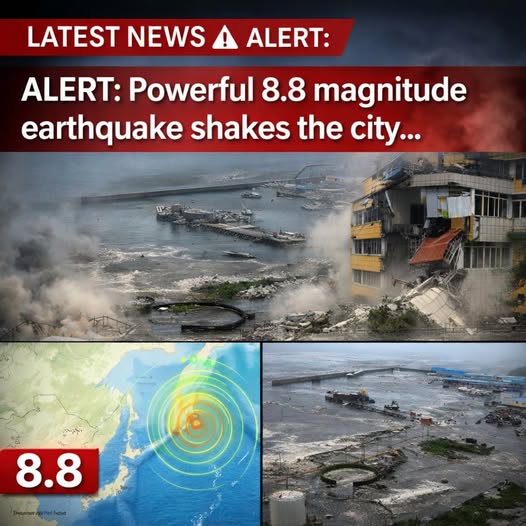
A major seismic event struck off the Kamchatka Peninsula on July 30, 2025, registering a magnitude of 8.8. The U.S. Geological Survey (USGS) initially estimated the earthquake at 8.0 before upgrading it twice to 8.8 after further analysis of seismic data. The epicenter was located approximately 119–136 km east-southeast of Petropavlovsk-Kamchatsky, at a shallow depth of roughly 19–20.7 km.
The earthquake occurred along the Kuril-Kamchatka arc, part of the Pacific Ring of Fire, an area renowned for high seismic activity due to the convergence of tectonic plates in the region. Geologists describe this zone as one of the most active subduction areas globally, where the Pacific Plate is forced beneath the Okhotsk Plate, producing frequent, sometimes very powerful, earthquakes and associated tsunamis.
Historical Significance
This event marks the strongest earthquake in the region since the 1952 Severo-Kurilsk earthquake, which reached an estimated magnitude of 9.0 and generated massive 9-meter tsunamis that claimed over 2,300 lives. Globally, the July 2025 earthquake ranks among the top ten most powerful recorded earthquakes in history, comparable to the 2011 Tōhoku earthquake in Japan (M9.0).
Earthquake historians note that events of this magnitude are rare but highly consequential. The combination of shallow depth and high magnitude typically results in strong ground shaking, potential structural damage, and secondary hazards such as tsunamis, landslides, and aftershocks.
Local Impacts in Kamchatka and the Kuril Islands
In Severo-Kurilsk on Paramushir Island, tsunami waves reportedly reached 4 meters (approximately 13 feet). Authorities evacuated roughly 2,000 residents to higher ground, prioritizing the safety of the community in the immediate aftermath. Emergency shelters were opened, and local disaster response teams coordinated with federal agencies to secure critical infrastructure.
Petropavlovsk-Kamchatsky experienced significant shaking. Reports described furniture falling, mirrors breaking, vehicles swaying, and mobile and power outages disrupting normal life. A kindergarten wall collapsed, though fortunately no casualties were reported. Minor injuries were documented, primarily from falling objects and debris. Emergency services, including medical, fire, and civil defense teams, were mobilized quickly.Vehicle theft prevention
Nearby Sakhalin Island also issued evacuations as a precaution, reflecting the broad regional awareness of tsunami risks. Ports, coastal infrastructure, and transportation networks were temporarily suspended to ensure public safety.
Tsunami Warnings Across the Pacific
The earthquake prompted tsunami alerts across multiple countries bordering the Pacific Ocean.
Japan
Japan issued evacuation orders affecting between 900,000 and 1.9 million residents in several prefectures. Coastal monitoring stations reported initial tsunami waves measuring between 30–50 cm (1–1.6 ft) in Ishinomaki, Nemuro, and Tokachi on Hokkaido, lower than the initially forecasted 1–3 meters. The Fukushima Daiichi nuclear plant evacuated approximately 4,000 staff as a precaution, with no reported damage to facilities.
United States
Hawaii issued statewide tsunami warnings, with waves up to 4 feet (~1.2 m) reported in Oʻahu and Maui. Emergency corridors were opened, and flight operations, as well as port activities, were temporarily suspended. In Alaska, waves under 30 cm were observed in Adak and Amchitka, and tsunami watches extended along the Aleutian Islands and the Panhandle. Local authorities on the U.S. West Coast, including California, Oregon, and Washington, issued advisories for possible waves up to 1.7 meters (~5.7 ft) in coastal locations such as Crescent City.
Other Pacific Regions
Alert systems were activated in Chile, Peru, Ecuador, Mexico, Taiwan, the Philippines, Indonesia, the Solomon Islands, and New Zealand. Chile declared a state of precaution in key coastal regions and suspended school activities as a preventive measure. India issued guidance to its citizens on the U.S. West Coast and in Hawaii and confirmed that nuclear facilities remained unaffected. No fatalities were reported in these distant regions.