Part 1: The Invisible Man
The Grand Ballroom of the Pierre Hotel smelled of white lilies, roasted duck, and the distinct, metallic scent of desperation. It was a sensory profile I knew well, though usually, I encountered it in destabilized regions of the world, not on Fifth Avenue.
I stood in the shadow of a massive marble pillar, nursing a glass of sparkling water. I was careful to keep my back to the wall, a habit picked up over two decades of ensuring no one could approach me unseen. My suit was charcoal gray, bespoke from a tailor on Savile Row, but intentionally devoid of any labels, sheen, or flair. To the untrained eye, I looked like a well-dressed security guard, or perhaps a boring accountant invited out of obligation.
That was the point. In my line of work, being memorable gets you killed. In this room, being memorable would only get me mocked.
In the center of the room, under the crushing weight of a crystal chandelier the size of a small car, my father, Robert Davis, held court. He was sixty-five, wearing a tuxedo that was slightly too tight around the waist, laughing too loudly at a joke made by a local Senator. He looked the part of the titan of industry he had once been. He swirled his scotch, clapped men on the back, and radiated the confidence of a man who owned the world.
He didn’t know that three months ago, the bank had initiated foreclosure proceedings on his estate. He didn’t know that his shipping logistics company was technically insolvent, bled dry by bad investments and a refusal to modernize. And he certainly didn’t know that the foreclosure had been halted seventy-two hours before the sheriff’s sale by an anonymous wire transfer of $2.4 million from a shell company called Vanguard Holdings.
He walked past my pillar, his eyes sliding over me as if I were a smudge on the expensive wallpaper. Then, he paused. The recognition hit him, not with affection, but with annoyance.
He stepped out of his circle of admirers and leaned in close, his breath smelling of expensive scotch and decay.
“Try not to eat too much, Thomas,” he whispered, a smile plastered on his face for the benefit of the room. “We’re paying per head. And frankly, you’re not worth the plate.”
I looked at him. I saw the broken blood vessels in his nose, the fear behind his eyes that he masked with arrogance. I saw a man drowning who thought he was waving.
“Good evening, Father,” I said, my voice neutral.
“Don’t call me that here,” he hissed, the smile never wavering. “You’re a guest. Barely. You’re lucky Michael insisted. If it were up to me, you’d still be in whatever gutter you crawled out of after you ran away.”
I didn’t blink. I didn’t defend myself. I just watched him walk away, knowing that I owned the plate he mentioned. I owned the table. I owned the wine he was drinking. I owned the roof over his head.
I was here for Michael, my younger brother. He was ten when I left—or rather, when I was thrown out at eighteen for refusing to join the family business and enlisting in the Army instead. To my father, service was for the poor, for the desperate. For a Davis to enlist was a social suicide.
Michael was the only one who had kept in touch, sending secret emails, updating me on his life. Today he was marrying Sophia, a woman I had met only once but liked immediately. She had steel in her spine and eyes that saw too much.
The wedding photographer began gathering the immediate family near the cake table for the official portrait. Michael spotted me from across the room. His face lit up, and he waved me over, mouthing, Come on!
I hesitated. I wasn’t part of this family, not really. I was a ghost they hadn’t managed to exorcise. But for Michael, I would play the prop.
I took a step forward, moving out of the shadows.
That was my mistake.
My Aunt Linda—a woman who measured human worth in stock options and country club memberships—intercepted me. She moved with the speed of a viper in silk.
Part 2: The Erasure
“Step aside!” Aunt Linda laughed, a bright, brittle sound that didn’t reach her eyes.
She placed a hand firmly on my chest. It wasn’t a gentle guide; it was a shove. A physical rejection.
“Aunt Linda?” I asked, looking at her hand on my lapel.
“Oh, Thomas, don’t be dense,” she said, lowering her voice but keeping the smile fixed for the cameras. “We’re taking the family portrait. We only want the successful people in the shot. You understand, don’t you? It’s for posterity. We don’t need a reminder of… well, of your choices.”
My brother saw the interaction. He tried to step out of the line, his face flushing. “Aunt Linda, stop. He’s my brother. He belongs in the photo.”
“He’s a grunt, Michael,” my father cut in, smoothing his tuxedo lapels as he took his place next to the bride. He didn’t even look at me. He spoke to the air, as if I were a bad smell. “He chose to carry a gun instead of a briefcase. He chose to be a servant of the state. If it weren’t for pity, no one would have invited a disgrace like him. Let him stand in the back where he belongs.”
The photographer, a young man with a hipster beard and a panicked expression, lowered his camera. “Sir, are you sure? Usually, we include all siblings…”
“Take the photo!” my father commanded, his voice booming. “We don’t have all night. Thomas, move.”
I looked at Michael. He looked torn, ready to argue, ready to ruin his own wedding to defend me.
I caught his eye and gave a nearly imperceptible shake of my head. Don’t.
I stepped back. I retreated into the shadows of the pillar. I accepted the erasure.
“Perfect!” Aunt Linda chirped, sliding into the spot where I should have been. “Smile, everyone!”
Flash.
The bulb popped, capturing the lie. The Davis Family: wealthy, united, perfect. A facade built on debt, delusion, and the silent funding of the son they despised.
I took a sip of my sparkling water. The carbonation burned my throat. I wasn’t hurt. You can’t be hurt by people you don’t respect. I was analyzing them. In the military, we call this Intelligence Preparation of the Battlefield. You study the enemy’s movements, their supply lines, their morale.
My father’s morale was artificially high, but his supply lines were cut. He was operating on fumes and fantasy.
The family dispersed as the DJ announced the speeches were starting. Sophia, the bride, walked past my pillar on her way to the stage. She was stunning in white lace, but her expression was fierce. She looked like she was marching into battle, not a reception.
She stopped in front of me. She didn’t look at me with the pity my father had weaponized. She looked at me with the cool, appraising gaze of someone who had seen the classified guest list.
“Are you leaving?” she asked quietly.
“I think it’s best,” I said. “I don’t want to cause a scene.”
“You aren’t the one causing scenes,” she said. “Stay. Please.”
“Sophia, my father…”
“Your father thinks he’s the host,” she interrupted. “I think it’s time we corrected the record.”
She turned and walked to the stage. She picked up the microphone.
“Testing,” she said.
The feedback whine sliced through the chatter, silencing the room.
Part 3: The Setup
My father leaned back in his chair at the head table, swirling his scotch. He whispered something to Aunt Linda, gesturing grandly at the floral arrangements—arrangements that cost $15,000, paid for by a credit card he didn’t know I had paid off the previous week.
“Wait until she thanks us for the venue,” I heard him say, his voice carrying in the sudden silence. “I told everyone I pulled strings to get this date. The Senator is impressed.”
On stage, Sophia stood tall. She took a deep breath. She wasn’t looking at her new husband. She wasn’t looking at her parents. She was scanning the back of the room, her eyes searching the shadows.
“I want to thank everyone for coming,” Sophia began, her voice steady. “My parents, for their love. And of course, the Davis family, for welcoming me.”
My father raised his glass, preening like a peacock. He nodded to the room as if accepting an award for ‘Best Father.’
“But,” Sophia continued, her tone shifting, sharpening like a blade, “there is a lot of deception in weddings. We pretend things are perfect. We pretend we have endless resources. We pretend we did things we didn’t do.”
The room went quiet. The clinking of silverware stopped. My father’s smile faltered. He exchanged a confused look with Aunt Linda.
“I come from a military family,” Sophia said. “My grandfather was a Marine. He taught me that stolen valor is a sin. He taught me that claiming credit for another soldier’s work is the lowest form of cowardice. He taught me that the loudest man in the room is usually the weakest.”
I put my hand on the brass doorknob of the exit. My instincts were screaming at me to leave. I had spent seventeen years being the “Gray Man”—invisible, efficient, silent. I commanded thousands of troops, managed budgets larger than the GDP of small nations, and operated in the highest corridors of the Pentagon. I didn’t want the spotlight. I didn’t want the drama.
“I believe in honor,” Sophia said, her voice rising. “And I believe credit should go where it is due.”
She looked directly at the back exit.
“Don’t go anywhere,” she commanded.
Every head in the room turned. They followed her gaze to the solitary figure standing by the door in the plain gray suit.
My father stood up halfway. “Sophia? What are you doing? That’s just Thomas. Ignore him.”
Sophia ignored my father. She stepped away from the podium. She didn’t walk to her father. She didn’t walk to Michael.
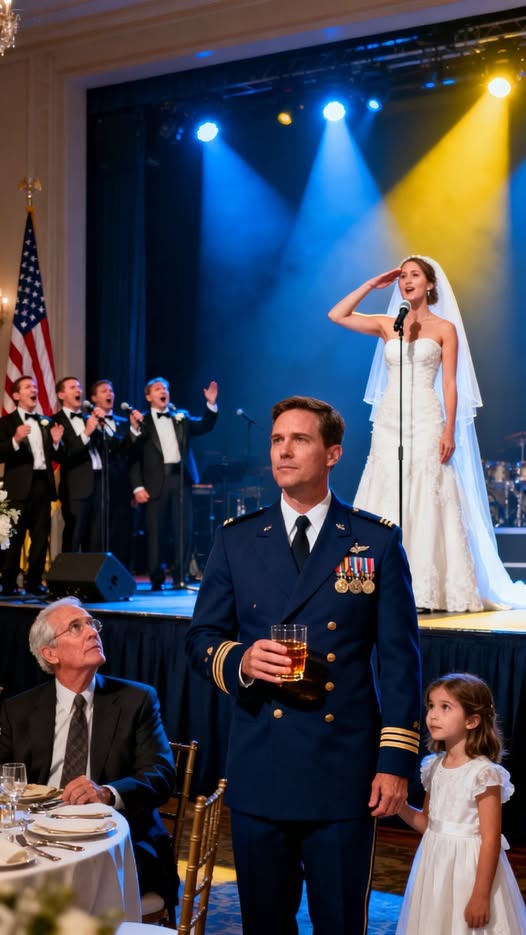
She turned her body toward the back of the room. She stood at attention, her posture perfect, her chin high. She raised her right hand to her brow.
Part 4: The General’s Salute
The silence in the room was absolute. It was a vacuum, sucking the oxygen out of the air.
“Please raise your glasses,” Sophia announced, her voice ringing clear as a bell, “to the man who paid for this wedding. The man who saved the Davis family estate from bankruptcy three months ago. And the highest-ranking officer this town has ever produced.”
She held the salute. Her eyes were locked on mine.
“Major General Thomas Davis.”
The gasp that went through the room was audible.
Major General.
My father choked on his scotch. He coughed violently, red wine spilling onto his shirt. “Major… General?” he sputtered, wiping his mouth. “That’s impossible. He’s a grunt. He’s an enlisted nobody. He washes trucks!”
“He commands the 10th Mountain Division, Robert,” a guest at a nearby table—Judge Harrison, a man who knew his military ranks—whispered in awe. “Do you have any idea how many stars that is? That’s two stars. He answers to the President.”
I slowly removed my hand from the doorknob.
I couldn’t leave now. To leave would be to disrespect the salute. It would be to disrespect the bride who had just thrown a grenade into her own reception to defend me.
I took a breath. I let the “Gray Man” drop.
I straightened my spine—a reflex honed over two decades of command, of briefing Congress, of leading men into fire. My posture shifted from “security guard” to “Titan.” The room seemed to shrink.
I returned her salute. Sharp. Precise. A cut of the hand that spoke of thousands of hours of drill.
“As you were,” I said softly.
But in the dead silence of the room, my voice carried to the stage like a thunderclap.
Sophia lowered her hand, smiling. “Thank you, General.”
My father stood up fully now, his legs shaking. He looked at the guests whispering, pointing at me. He looked at the Judge, who was now standing up out of respect. He looked at the Senator, who was looking at me with sudden, intense interest.
He tried to reclaim control. He tried to be the patriarch one last time.
“Thomas!” he barked, though his voice cracked and squeaked. “Get over here! Explain yourself! Did you lie to us?”
I looked at him across the expanse of white tablecloths. I looked at the distance between us—not in feet, but in character.
I began to walk toward him. The crowd parted instantly. People who had ignored me five minutes ago were now pulling their chairs in, making a wide path.
I stopped ten feet from the head table.
“I didn’t lie, Father,” I said calmly. “You just never asked. You saw a suit and assumed I was a clerk. You saw my silence and assumed I was weak. You assumed I was a failure because I didn’t chase your version of success.”
“But… the money,” he stammered. “Vanguard Holdings? That was you?”
“Vanguard is my private investment firm,” I said. “I started investing my hazard pay in tech startups fifteen years ago. I got lucky. Then I got smart.”
“You paid for the house?” Aunt Linda whispered, her face pale.
“I bought the debt,” I corrected her. “Which means I own the mortgage. Which means, Aunt Linda, that you are currently drinking champagne in a house that belongs to the ‘disgrace’ you shoved out of the photo.”
Part 5: The Retreat
Aunt Linda looked like she might faint. She rushed forward, pushing past a waiter, her face transforming into a mask of desperate fawning.
“Thomas! My nephew! A General! Why didn’t you say anything? Oh, we are so proud! Come, come take a picture with the bride! We need to redo the portrait! The photographer is still here!”
She reached for my arm—the same arm she had shoved minutes ago.
I stepped back. A simple, smooth motion. I let her hand grasp empty air.
“I believe you only want the ‘successful’ people in the shot, Linda,” I said coldly. “And by your definition, I’m just a disgrace who carries a gun.”
“We were joking!” my father stammered, sweating profusely now. “It’s banter! Family banter! You know how we are! Thomas, if you have money… well, the logistics business could use an investor like you. We could rename it ‘Davis & Son’. Think of the legacy! General Davis and Father!”
He was trying to pivot. He was trying to rewrite history in real-time. It was pathetic. It was the frantic clawing of a man falling off a cliff.
“There is no ‘Davis & Son’,” I said. “There is just you, living on the charity of a stranger you kicked out at eighteen.”
I turned away from him. I walked over to Michael and Sophia.
Michael was crying. He hugged me, holding on tight.
“I didn’t know,” Michael whispered. “I knew you were doing well, but I didn’t know… this. I didn’t know you saved the house.”
“I wanted you to have a good day,” I said. “I didn’t do it for him. I did it for you.”
I reached into my inside jacket pocket and pulled out a thick envelope. I handed it to Michael.
“What is this?” he asked.
“This is the deed to this estate,” I said. “I transferred it into your name and Sophia’s name this morning. It’s your wedding gift.”
My father gasped. “You gave it to him? But I live here! It’s my house!”
I looked at my father over Michael’s shoulder.
“You live here at their pleasure,” I said. “Michael is the owner now. If he wants to keep you, that’s his choice. But you will never hold a roof over his head again. You will never threaten him with inheritance again. Because you have nothing left to give.”
I looked at Sophia. “Thank you for the salute, Sophia. But you didn’t have to do that.”
“Yes,” she said. “I did. Honor must be paid. And bullies must be stopped.”
I nodded. “I have to go. My leave ends at 0800.”
I turned to leave.
My father tried to block my path again, just like he had at the entrance. He looked desperate, small, a king whose crown had been melted down.
“You can’t just walk away!” he shouted. “I am your father! I made you!”
I stopped. I looked down at him. He was shorter than I remembered.
“No, Robert,” I said softly. “The Army made me. The war made me. You just made me leave.”
I walked past him. He didn’t reach out this time. He couldn’t. The wall of dignity I had built was too high for him to scale.
Part 6: The Final Deployment
I walked out into the cool night air. The humidity had broken, and the sky was clear. The silence of the night was a welcome relief from the noise of the ballroom.
A black government SUV with tinted windows was idling at the curb. Two men in dark suits stood by the doors.
My aide, Captain Lewis, opened the rear door as I approached. He snapped a salute.
“Good evening, General,” Lewis said. “Eventful night?”
“Mission accomplished, Captain,” I said, sliding into the leather seat. “Target secured. Hostiles neutralized.”
I looked back at the hotel entrance one last time.
My father was standing under the awning. He was watching the car. He looked like a man who had just realized he had thrown away a winning lottery ticket because it was crumpled.
He wasn’t grieving the loss of his son. He was grieving the loss of the asset. He was grieving the loss of the bragging rights. My son, the General. He would try to say it tomorrow, but everyone in that room knew the truth now.
I didn’t feel anger anymore. I didn’t feel the need for his validation. The salute from Sophia, the hug from Michael—that was real. That was enough.
“Where to, sir?” Lewis asked, climbing into the front seat.
“The airfield,” I said, unbuttoning the civilian jacket to reveal the military ID clipped to my shirt. “Wheels up in forty minutes. We have work to do.”
“Copy that, sir.”
The car pulled away. I watched the hotel shrink in the rearview mirror. The lights of the ballroom faded, replaced by the streetlights of the highway.
I took out my phone.
One notification.
Friend Request: Robert Davis.
I looked at the name. I remembered the boy who had begged for approval. I remembered the teenager who was told he was worthless. I remembered the man who had shoved me out of a photograph.
I pressed Delete.
Then I pressed Block.
Some bridges are burned for a reason—to keep the enemy from following you home.
I put the phone away and looked forward, into the dark, toward the horizon where my real family—my division—was waiting.