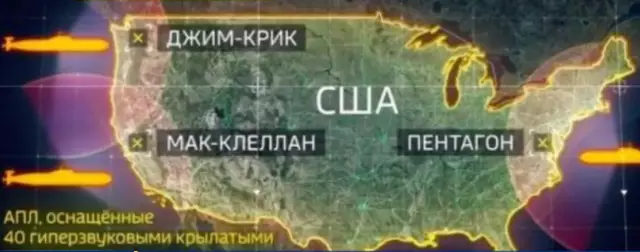
A chilling broadcast from Russian state television has resurfaced online, reigniting global anxiety after Kremlin-linked figures renewed warnings that the world may be inching closer to a third global war. The footage, which originally aired in 2019, displays a detailed map allegedly showing specific U.S. military and government locations that would be targeted by Russian nuclear missiles in the event of a full-scale conflict between Moscow and Washington.
The renewed circulation of the map comes amid escalating rhetoric from Russian officials, who in recent months have repeatedly raised the specter of nuclear war during debates over Ukraine, NATO expansion, and Western military support for Eastern Europe. While the video is several years old, its reappearance at this particular moment has struck a nerve worldwide, especially as tensions between Russia and the West remain at their highest point in decades.
A Broadcast Designed to Terrify
The map was originally unveiled during an episode of the Russian state television program Vesti Nedeli, one of the country’s most influential political news shows. The segment featured a simulation of how Russia would allegedly respond if attacked by Western forces.
What made the broadcast particularly disturbing was not just the mention of nuclear retaliation—but the visual display of exact American targets, plotted on a map with ominous commentary explaining how quickly Russian missiles could reach them.
According to the broadcast, Russia would use hypersonic missiles capable of striking U.S. targets in as little as five minutes after launch. The segment portrayed the response as both swift and unavoidable, reinforcing the Kremlin’s narrative that its nuclear capabilities serve as the ultimate deterrent against Western aggression.
High-Profile Targets and Surprising Inclusions
Unsurprisingly, the map highlighted iconic centers of American political and military power, including:
- The Pentagon in Arlington, Virginia
- Camp David, the presidential retreat in Maryland
However, what truly shocked viewers was the inclusion of lesser-known and even decommissioned military sites, suggesting that Russia’s targeting strategy extends far beyond symbolic landmarks.
Among the locations identified:
- Fort Ritchie, Maryland – A former U.S. Army training facility that officially closed in 1998
- McClellan Air Force Base, California – Decommissioned in 2001
- Jim Creek Naval Radio Station, Washington State – A highly strategic communications base still in operation
The inclusion of closed bases sparked immediate debate among analysts. Some argue that the list reflects outdated intelligence, while others believe the selection is symbolic—designed to show Russia’s historical awareness of America’s military footprint rather than its current force posture.
Still, the message sent by the broadcast was unmistakable: no region of the United States would be beyond reach in a nuclear exchange.
Russia’s Longstanding Nuclear Threat Strategy
For decades, Russian officials and state-controlled media have used nuclear power as a psychological weapon, reinforcing the idea that Russia remains a superpower capable of devastating retaliation. Since the invasion of Ukraine, these nuclear references have accelerated dramatically, appearing in speeches, military exercises, and prime-time television discussions.President Vladimir Putin himself has repeatedly alluded to Russia’s nuclear arsenal as a warning to NATO not to intervene directly in Ukraine. Russian propagandists have gone further—sometimes openly fantasizing about nuclear strikes on London, Berlin, and Washington during televised debates.
The resurfaced U.S. target map is now being viewed within this broader pattern: not merely as an old broadcast, but as part of a consistent intimidation strategy.
Rogozin Reveals UK Target List
The reappearance of the U.S. map follows recent comments by Dmitry Rogozin, Russia’s former deputy prime minister and one-time head of its defense industry. Rogozin recently claimed that Russia has also identified 23 key targets in the United Kingdom that would be struck in the event of a direct NATO-Russia war.
Unlike the U.S. map, Rogozin’s UK list focused heavily on military manufacturing, defense production, and weapons development facilities rather than solely on political headquarters.
The alleged UK target list includes major industrial hubs tied to the British defense sector, such as:
- Glasgow – BAE Systems, Rolls-Royce, Thales
- Belfast – Harland & Wolff, Spirit AeroSystems, Thales
- Barrow-in-Furness – BAE Systems submarine production
- Bristol – Airbus, Leonardo, MBDA, Rolls-Royce
- Aldermaston – Atomic Weapons Establishment
- Derby – Rolls-Royce nuclear propulsion
- Stevenage – Airbus and MBDA missile manufacturing
- Sheffield – Sheffield Forgemasters heavy steel production
Rogozin has claimed that these locations are “legitimate military-industrial targets,” accusing the UK of acting as a weapons supplier to Ukraine. British officials have dismissed his remarks as reckless propaganda designed to frighten civilians rather than reflect any actionable intelligence.
How Real Is the Threat?
Western military analysts largely agree on one critical point: the likelihood of an actual Russian nuclear strike on the United States or the UK remains extremely low due to the guaranteed reality of mutual destruction. Any such attack would instantly trigger NATO’s Article 5 response and result in Russia itself being annihilated.
However, experts emphasize that nuclear signaling does not exist merely to predict war—it exists to shape behavior. By repeatedly displaying nuclear scenarios on television, the Kremlin seeks to:
- Reinforce internal public support
- Intimidate Western populations
- Pressure foreign governments to reduce military aid to Ukraine
- Project strength amid battlefield setbacks
In this context, the resurfaced map serves less as an operational battle plan and more as a strategic psychological message.
Hypersonic Missiles and the Five-Minute Fear
One of the most alarming elements of the broadcast was its focus on hypersonic missile technology, which travels at speeds exceeding Mach 5. At such velocities, detection windows shrink dramatically, limiting the reaction time available to U.S. missile defense systems.
During the segment, presenters emphasized that certain American targets could be reached in under five minutes, dramatically reducing warning periods and command decision time. Whether this claim reflects real operational capability remains debated, but the mere suggestion heightens public fear.
Military experts caution that while Russia does possess advanced hypersonic weapons, real-world deployment under wartime stress would likely face technical and logistical complications. Nonetheless, the message was delivered clearly: speed equals inevitability.
Why Decommissioned Bases Still Matter
The inclusion of inactive sites such as Fort Ritchie and McClellan Air Force Base puzzled many observers. Some analysts believe these sites still hold strategic infrastructure, underground facilities, or communications relay components that remain relevant despite public closures.
Others suggest the list reflects legacy targeting doctrines that have not been fully updated—or that Russian intelligence prioritizes historical patterns of American military organization when constructing deterrence messaging.
Regardless of interpretation, the symbolism remains powerful. It suggests that Russia views the entire territorial depth of the United States as militarily relevant, not just its front-line installations.
Propaganda or Pre-War Signaling?
One of the most debated questions is whether these televised maps should be interpreted as pure propaganda or early-stage signaling.
Historically, Russian military doctrine does include “escalate to de-escalate” concepts, in which limited nuclear threats are used to force an adversary into negotiations. This makes nuclear rhetoric more than just bluster—it becomes a diplomatic lever.
However, many intelligence officials caution against overreacting to televised segments alone. They argue that true attack preparations would involve invisible logistical shifts, not dramatic studio graphics.
Still, public broadcasting of specific nuclear targets is rare—even by Cold War standards—making this resurfaced footage particularly unsettling.
The Information War Behind the Fear
The resurgence of the map also highlights the modern battlefield of information warfare. In an era where viral clips spread across social media within minutes, psychological fear now travels faster than missiles.
Russian state TV content is increasingly consumed far beyond Russia’s borders, often repackaged by international accounts that amplify its impact. The resurfaced map has now been viewed millions of times across platforms, often stripped of original context and paired with apocalyptic headlines.
This dynamic allows old footage to assume new strategic meaning, particularly when global tensions rise.
NATO and U.S. Officials Respond
While Western governments have avoided directly responding to the resurfaced map, NATO officials continue to stress that the alliance remains fully prepared to defend all member states.
Behind closed doors, defense leaders acknowledge that Russia’s nuclear messaging must be taken seriously—but not literally. The emphasis remains on deterrence stability, crisis communication, and preventing miscalculation.
Publicly, U.S. officials maintain that any nuclear threat against American territory would result in “overwhelming and catastrophic retaliation.”
A World Living Under the Shadow Again
For many observers, the most chilling aspect of the resurfaced map is not its technical details—but what it symbolizes. It marks a return to Cold War-style nuclear fear, in which entire cities exist under invisible crosshairs.
Younger generations who never lived through Cold War drills are now encountering, perhaps for the first time, a world where nuclear confrontation is openly discussed on prime-time television.
And while no missiles are currently flying, the psychological impact is already taking a toll.
Final Reality Check
Despite the fear generated by the broadcast, experts continue to emphasize that nuclear war remains the least rational option for any state, including Russia. Every major power understands that there would be no winners—only extinction-level devastation.
Yet the resurfacing of this map is still a stark reminder that humanity continues to live beneath vast arsenals capable of erasing civilization within minutes.
For now, diplomacy holds. Missiles stay in silos. Cities remain intact.
But the images broadcast on Russian state TV—now replayed across the internet—serve as a chilling warning of what failure would look like.
