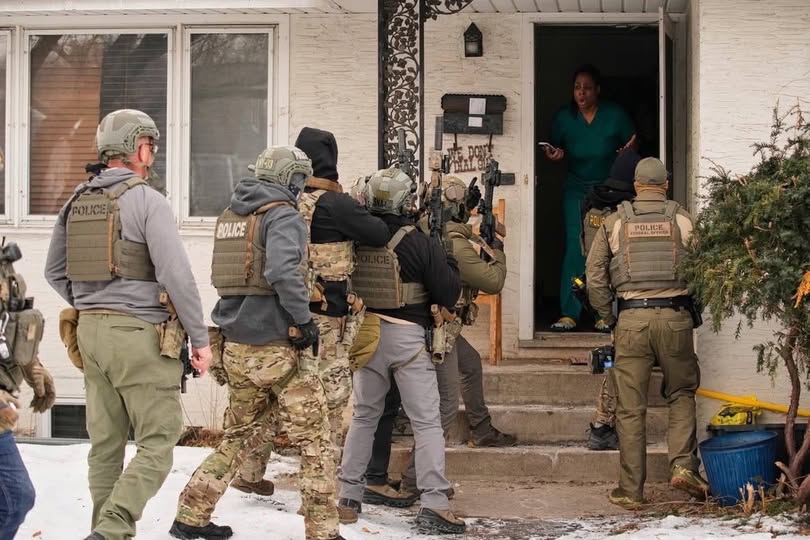
In early January 2026, neighborhoods across the Minneapolis–St. Paul area found themselves on the front lines of one of the most aggressive immigration enforcement operations in decades. Federal agents with U.S. Immigration and Customs Enforcement (ICE), backed by the Department of Homeland Security, descended on homes — carrying ballistic gear, battering rams, and arrest warrants — in a surge described by officials as a crackdown on serious offenders and by critics as an overreach that terrorized communities.
A Raid That Shocked a City
In one of the most widely reported incidents, a federal ICE officer shot and killed a 37-year-old woman, Renee Nicole Good, during an encounter in south Minneapolis on January 7. Good was standing near her vehicle in the snow when an agent fired multiple rounds, according to local authorities and family statements. The U.S. government has described the shooting as an act of self-defense, claiming the vehicle was used as a weapon, while city officials and bystanders have disputed that characterization — saying video evidence does not clearly show a threat to officers.
Her death, coming less than a mile from the site of the 2020 murder of George Floyd, ignited protests and renewed debate over federal enforcement tactics. Local leaders called for accountability and an independent investigation, while many residents expressed fear that the new federal sweep was ripping apart lives rather than strengthening public safety.
Sweeping Enforcement and Civil Rights Concerns
The surge — part of an operation referred to internally as Operation Metro Surge — deployed thousands of agents to the Twin Cities, targeting undocumented immigrants as well as individuals with previous convictions or outstanding immigration matters. ICE actions included forced entries into private residences, arrests of individuals at their homes, and reports of detentions without visible judicial warrants, according to civil liberties advocates.
The American Civil Liberties Union (ACLU) filed a lawsuit against the administration on behalf of people from Somali and Latino communities, alleging racial profiling, unlawful arrests, and violations of civil liberties tied to the enforcement surge. Protesters and local officials described scenes that felt more like militarized occupation than law enforcement, and several state leaders called the federal operation an “invasion” of Minnesota’s sovereignty.
The Human Impact Beyond Headlines
While headlines focus on shootings and legal battles, everyday stories reveal the deeper personal toll. Families reported agents bursting through doors, children watching in fear as parents were handcuffed, and residents unsure whether they would be the next targets of federal action. Local community groups and civil rights lawyers have documented several cases in which ICE’s legal authority to enter homes has been questioned, sparking urgent calls for transparency and judicial oversight.
For many in Minnesota’s immigrant communities — some of whom have lived in the United States for decades, worked in essential industries, and raised children born as U.S. citizens — the enforcement surge has brought anxiety, mistrust, and trauma. Advocates argue that broad, aggressive tactics risk undermining public safety by deterring cooperation with local authorities, fracturing families, and eroding constitutional protections.
A City Divided and Searching for Answers
As protests continue and lawsuits move through the courts, Minnesota faces a moment of reckoning over federal power, racial equity, and the rights of residents regardless of immigration status. The nation watches as Minneapolis grapples with questions that extend far beyond its snowy streets — about how the United States enforces its borders and what happens when that enforcement comes to someone’s front door.